
Nine Acquisitions, Eight Platforms: How WAD Capital's Institutional Model Compresses Search Fund Timeline
Eight operators. Nine acquisitions. Ten months.
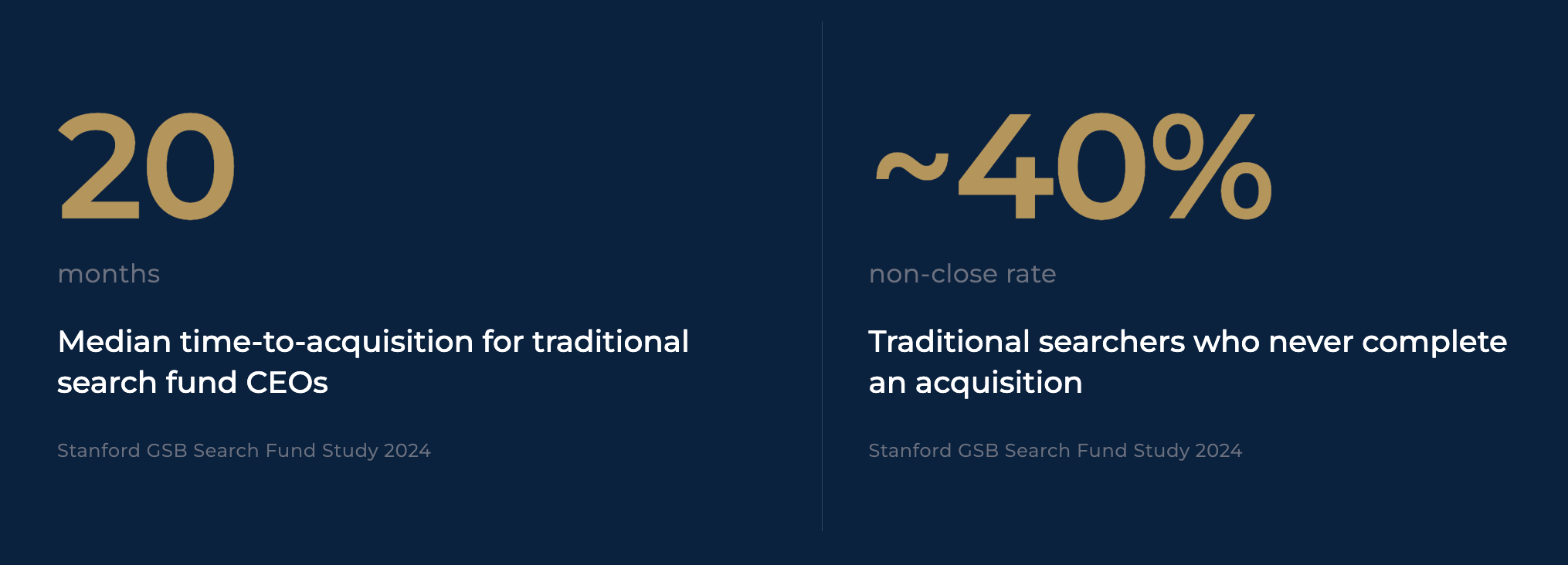
A traditional search fund CEO takes a median of 20 months to close an acquisition, according to the 2024 Stanford GSB Search Fund Study. Roughly four in ten never close at all. WAD Capital, a Brussels-based institutional search fund regulated by the FSMA, has closed nine SME acquisitions across eight platforms since its first close in October 2025. Four of those acquisitions closed inside a single month: Ausloos Verpakkingstechniek in Aarschot, EURO-M Flexible Packaging in Ghlin, Lardenoit Finance & Insurance in Temse, and E-Demonstrations in Wilrijk. Each was led by a different CEO-in-Residence acquiring their own company. The velocity difference reflects a structural choice. Institutional Entrepreneurship Through Acquisition (ETA) provides shared sourcing infrastructure, pre-tested legal frameworks, and a cohort of CEOs-in-Residence searching in parallel against the same fund. A solo searcher building each of these from scratch is not competing on the same clock.
How Long Does It Take a Search Fund CEO to Acquire a Company in Europe?
The Stanford data is the reference point. The 2024 Stanford GSB Search Fund Study tracked 681 search funds formed in the United States and Canada since 1984 and reports a median time-to-acquisition of 20 months. That figure has held steady across successive biennial studies. The same study reports that approximately 40% of traditional searchers never close a deal at all. The reasons are structural. A solo searcher spends the first six to nine months of a search building infrastructure that a professional acquisition process should already have in place: legal templates, financial models, outreach systems, target databases, financing relationships.
European search timelines have historically run longer. The 2024 IESE International Search Fund Study tracks 320 international search funds and notes that 62% of all international acquisitions have occurred since 2020. European searchers face additional friction. Cross-border legal complexity. Multiple languages in a single negotiation. Sellers who are older on average and more cautious about who they sell to. A first-time European searcher building the process from zero is not looking at 20 months. They are often looking at 24 or more.
Institutional ETA reframes the timeline by removing the setup phase entirely.
What Does WAD Capital's Nine-Acquisition Milestone Actually Look Like?
Nine acquisitions across eight platforms since October 2025. Four of those closes landed in a single month, June 2026:
Ausloos Verpakkingstechniek is a 49-year-old specialist in end-of-line industrial packaging machinery, headquartered in Aarschot in Flemish Brabant, with around 35 employees serving clients including Petronas, ForFarmers, and Agristo. Thomas Muyldermans acquired Ausloos from the Ausloos family after Ernest and his son Tom Ausloos had built the business over five decades.
EURO-M Flexible Packaging S.A., founded in 1968 in Ghlin, produces high-performance flexible packaging films for the European food industry. Its product range spans coated films, aluminium foil, lidding films, and specialised packaging for cheese and dairy applications. Sammy Lasseel acquired EURO-M, bringing 25 years of international manufacturing leadership and a track record of market segmentation into the business.
Lardenoit Finance & Insurance is the largest independent insurance broker in the Waasland region of East Flanders. Founded in 1989 by Rudy Lardenoit in Temse, the firm operates across three offices serving individuals, entrepreneurs, and SMEs with genuinely independent advice. Mathieu Loquet acquired Lardenoit with a mandate to preserve the firm's identity and independence while building its operational foundation.
E-Demonstrations has been Antwerp's integrated events and infrastructure partner since 2001. Founded by Yo Engelen, it operates five divisions covering events, print & signage, custom carpentry, emergency-response infrastructure, and container buildings, and was recognised as Antwerp SME of the Year in 2024. Nina Bos became CEO of E-Demonstrations after completing her search through the CEO-in-Residence programme, joining Yo to lead the company's next chapter.
Four companies. Four sectors. One month.
What Structural Advantages Compress the Search Fund Timeline?
A first-time solo searcher builds the acquisition process while running it. Their first pipeline meeting happens after they have already spent three months incorporating a vehicle, hiring counsel, and configuring a CRM. Their first outreach email goes out around month four. By month nine, they have learned that their initial sector thesis was too broad and their outreach language reads too much like private equity cold calling. The process improves. The clock keeps running.
Institutional ETA removes that phase. A CEO-in-Residence joining WAD Capital's programme has operating credentials to a shared deal sourcing system on day one. Legal templates tested across completed acquisitions are already in the shared drive. Financing relationships are already in place through WAD Capital Fund I, which provides institutional acquisition capital rather than requiring the CEO-in-Residence to raise it deal by deal. The Investment Memo Creation phase, market analysis, expert interviews, and target mapping run against infrastructure that already exists.
The cohort itself is the second structural advantage. Multiple CEOs-in-Residence search in parallel against the same institutional base. When one CIR closes a deal, the sequencing that worked, the language that landed with the seller, and the diligence workstream that held up all become available to the CIRs still in search. Solo search funds do not have this structure. What one WAD CIR learns in July is available to another CIR in August.
How Does the European Milestone Compare to Traditional Search Fund Benchmarks?
Two datasets read together. The Stanford study covers the mature North American market. The IESE International Search Fund Study covers the international expansion. Both report the same core mechanic. Institutional-quality infrastructure, applied consistently, compresses the timeline.
The European context adds a layer. According to the 2024 European Commission SME Performance Review, approximately 450,000 EU firms transfer ownership each year, with an estimated 150,000 at risk of an unsuccessful transfer. The KfW Nachfolge-Monitoring Mittelstand study reports that 30% of German SME owners are now over 60. This is not a demand-constrained market. The bottleneck is buyer-side infrastructure: whether a credible institutional buyer can present themselves to a founder who has spent thirty years building a business and needs to trust the person walking into their office.
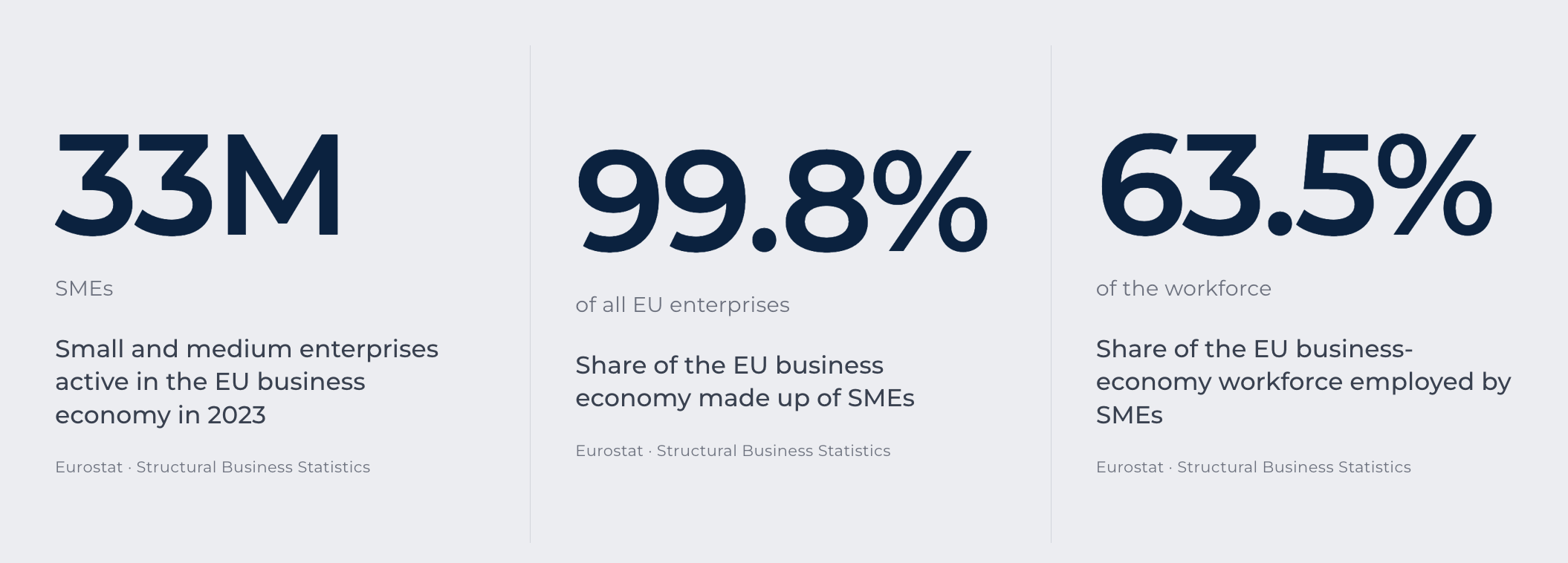
WAD Capital's nine acquisitions across eight platforms since October 2025 sit inside that market context. The founders selling those companies were not optimising for the highest bid. They were optimising for the right successor. What institutional ETA offers is a credible successor plus the capital and infrastructure to execute the transaction on a professional timeline.
What Comes Next After Nine Acquisitions?
The portfolio is not the finish line. Each of the eight platforms now runs on its own operational timeline, with its CEO-in-Residence executing the value creation plan agreed at acquisition. Some are focused on strengthening internal processes before pursuing growth. Some are looking at buy-and-build strategies inside fragmented adjacencies. All of them have access to the same operational support layer, board governance, and market intelligence that WAD's Operations function provides across the portfolio.
