
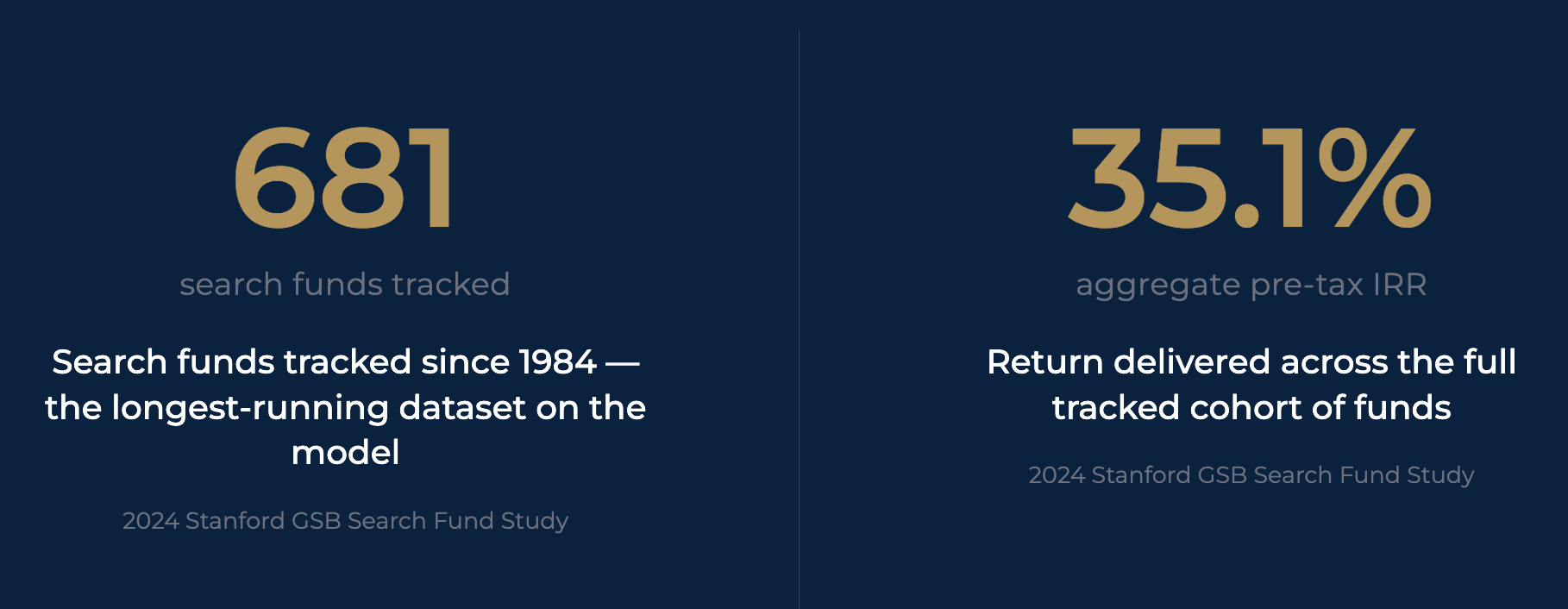
A search fund is an investment structure in which an individual, called a searcher, raises capital in two stages to buy and run a single company. The first stage funds an eighteen to twenty-four month search for an acquisition target. The second stage, raised only once a target is identified, funds the purchase itself. The searcher then becomes the company's CEO, typically holding meaningful equity alongside the investors who backed the search. The 2024 Stanford GSB Search Fund Study tracked 681 search funds since 1984 and recorded a 35.1% aggregate pre-tax internal rate of return. Most search funds are run by a solo operator with no institutional infrastructure. WAD Capital operates Europe's only institutional search fund, replacing solo search with a funded cohort model.
That's the model in one paragraph. The rest of this is what actually happens inside it, where the European version diverges from the American original, and why the distinction matters if you're an executive weighing whether this is a real path or a niche financial curiosity.
How Does a Traditional Search Fund Work Step by Step?
Start with the mechanics, because most of the confusion about search funds comes from skipping straight to the pitch.
Stage one is the search itself. A searcher (or occasionally a two-person team) raises what's called search capital from a small group of investors, enough to cover a salary and search expenses for roughly two years. There is no deal yet. The investors are betting on the person, not the target.
Stage two only happens if stage one produces a company worth buying. Once a target is identified, negotiated, and underwritten, the searcher goes back to investors, often the same ones, sometimes a wider pool, and raises acquisition capital to actually fund the purchase. This is a separate raise with separate terms. The search investors typically get preferential rights to participate, but nothing is guaranteed until the deal closes.
Then the searcher runs the company. Not as a hired executive reporting to a board that picked the target. As the CEO who found it, bought it, and now owns a piece of it.
This is the original model, invented at Stanford Graduate School of Business in the early 1980s and formalised in academic research since. It is almost entirely a solo pursuit. One person, occasionally two, with no shared search infrastructure and no peer group going through the same thing at the same time.
What's the Difference Between a Traditional Search and an Institutional Search Fund?
The traditional model puts nearly all of the operational burden on one person. Sourcing deal flow, running financial models, managing a data room, negotiating with a seller's lawyer, all of it falls on a searcher who is, by definition, doing this for the first time. Some searchers thrive on that. Many burn a significant fraction of their two-year runway just building the infrastructure a more experienced team would already have.
An institutional search fund changes who carries that burden. Instead of one searcher raising capital alone, an institutional programme funds multiple executives simultaneously, under one balance sheet, with shared operational support behind them. WAD Capital, for instance, provides acquisition financing without requiring the CEO-in-Residence to personally raise or contribute capital, which removes the single biggest structural barrier that keeps otherwise-qualified executives from attempting a solo search in the first place. Co-investment is welcomed, not required.
That distinction, solo versus institutional, is the one most CIR candidates arrive not fully understanding. It is also the one that determines whether the two years ahead of you look like building a company from a spreadsheet on your kitchen table, or like joining a structured programme with people doing the same thing next to you.
How Does WAD Capital's Institutional Model Work in Europe?
WAD Capital runs its programme as a funded cohort. A group of CEO-in-Residence candidates search simultaneously, backed by the same institutional capital base, working through the same three broad phases every acquisition goes through: search and diligence, negotiation and acquisition, and post-acquisition operation. When one CIR in the cohort hits a due diligence problem specific to, say, a family-owned distribution business, the group has typically already worked through something adjacent. Solo searchers don't get that. There is nobody else in the room who has seen the same category of problem three weeks earlier.
Geographically, this plays out Benelux and France. HBI Tyres & Wheels, a niche tyre and rim manufacturer based in Tholen in the Netherlands, is one example of what an acquisition inside this model looks like in practice: a founder-led business with a specific, defensible market position, acquired by a CIR who then stepped into day-to-day leadership. It is a different kind of proof than a return figure. It's a company that existed before the acquisition and still exists, with a different person running it.
What Track Record Do Search Funds Have in the US and Europe?
The Stanford GSB Search Fund Study, updated in 2024, remains the definitive dataset on the model: 681 funds tracked since 1984, an aggregate pre-tax IRR of 35.1%. That number carries real weight in the US and Canadian markets where the bulk of that dataset originates.
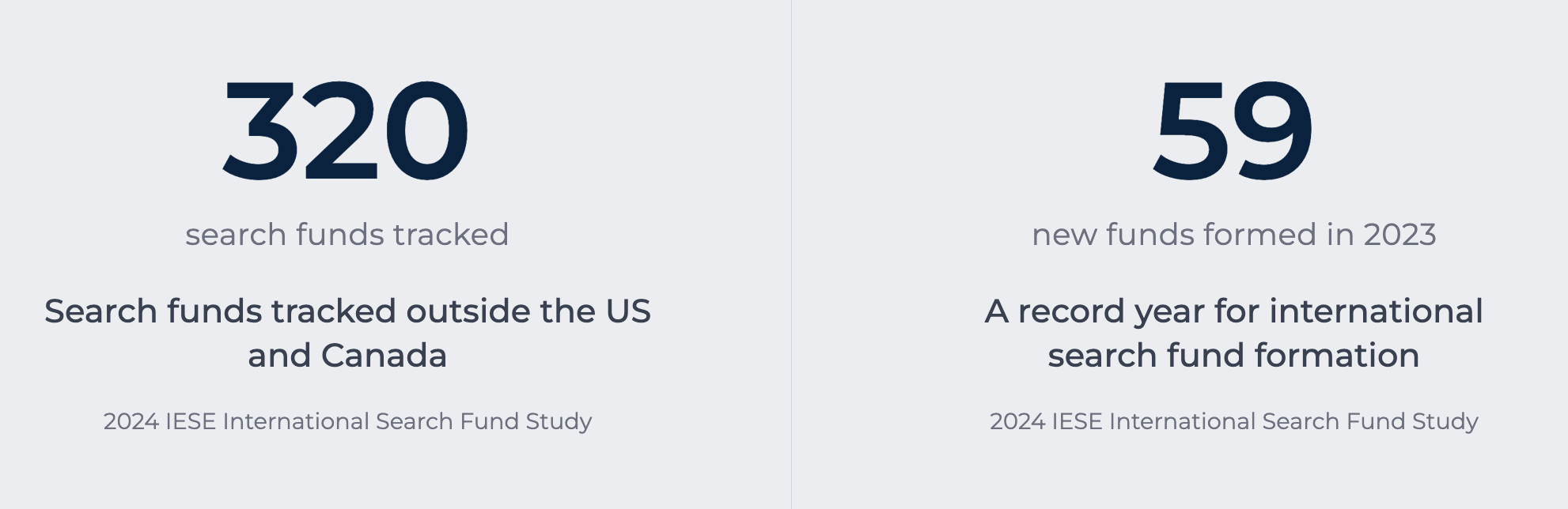
Europe's data is thinner but growing. The 2024 IESE International Search Fund Study tracked 320 search funds operating outside the US and Canada, and recorded a record 59 new international funds formed in 2023 alone. International searchers, per the same study, are achieving acquisition success rates that outperform the historical domestic rate. The model is exporting itself. What it looks like once it arrives in a given market, solo or institutional, well-resourced or improvised, is still being worked out fund by fund, country by country.
Is the Search Fund Model a Realistic Path for a Corporate Executive?
Mostly, yes, for the specific kind of person it suits: someone with real operational experience, ten to twenty years of it typically, who wants to run something rather than advise on it. It is not a faster or easier route to entrepreneurship than starting a company from scratch. It is a different one, built around buying cash flow and a customer base that already exist rather than creating them.
What changes the odds is whether you're doing it with two years of solo search runway and a spreadsheet, or inside a cohort with institutional financing and people three deals ahead of you working the same problem set. That's the actual decision underneath the search fund question, and it's worth being honest with yourself about which version you're prepared for before you start.
If you want the detail on how WAD Capital's programme is structured, the CEO-in-Residence FAQ covers mechanics, timeline, and financing. The current cohort of Residents shows who's searching and in which sectors right now. Applications for the next cohort are open at /join-cir.
