
WAD Capital is a Brussels-based private equity firm that operates as an institutional search fund in Belgium. The firm backs experienced executives, called CEOs-in-Residence, who each search for one SME facing succession in Benelux and France, acquire it, and run it as CEO. WAD Capital's first fund is FSMA-registered and backed by the European Investment Fund, part of the EIB Group. Other search fund activity in Belgium follows the traditional or self-funded models, where an individual searcher raises capital from international search fund investors or funds the search personally. The model is expanding well beyond its North American origin: the Stanford GSB Search Fund Study 2026 counts 503 known core search funds outside the United States and Canada as of 31 December 2025. Of those that had finished searching, 220 had acquired a company.

What Is an Institutional Search Fund?
A search fund starts with a person rather than a portfolio. An experienced executive decides to buy one established company and run it for the long term. In the original version of the model, that executive raises a small pool of money to pay for the search, finds a company, and then returns to the same investors to fund the purchase. Each piece, from the investor group to the lawyers to the acquisition financing, gets assembled by the searcher along the way.
An institutional search fund keeps the core idea and moves the infrastructure. A regulated fund commits capital across many acquisitions. Executives search in parallel, sharing support for sourcing, due diligence and legal work. Each executive still buys one company and still becomes its CEO. What changes sits behind that person: a standing fund, an experienced team, and a process that has already carried deals through to closing.
How Do Search Funds Operate?
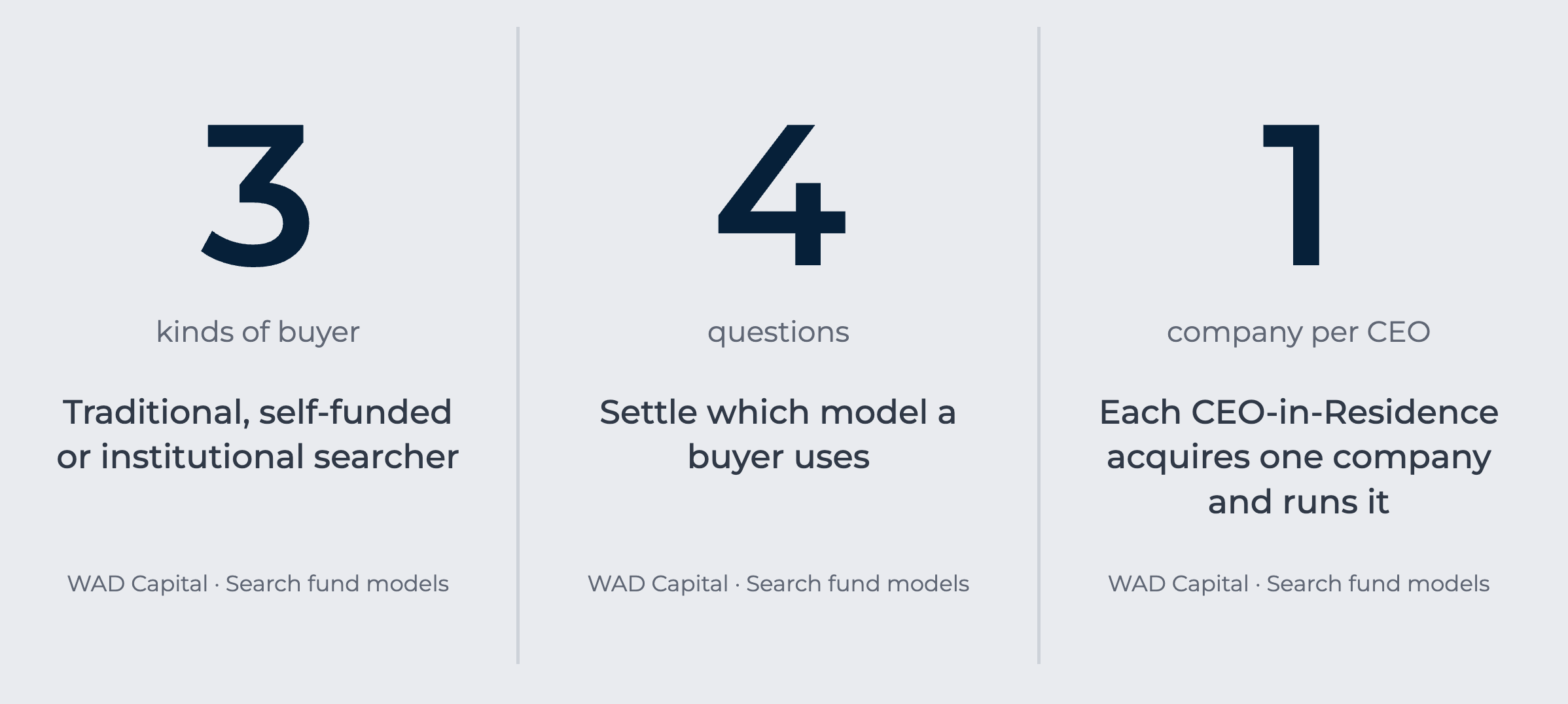
A Belgian business owner who takes a call from a searcher could be speaking to one of three kinds of buyer, and the difference matters more than the introduction suggests.
One is a traditional searcher. This executive has raised search capital from a group of investors, often specialist search fund investors based outside Belgium, and will go back to them for the acquisition money once a company is found. A self-funded searcher is the second possibility: someone paying for the search personally and arranging acquisition financing deal by deal, typically combining bank debt with private investors. Then there is the institutional searcher, a CEO-in-Residence working inside a fund that has already raised its capital.
How Does WAD Capital Operate as a Search Fund?
WAD Capital runs the institutional model from Brussels, across the Benelux and France. Executives join its CEO-in-Residence programme, a structured multi-phase process covering investment thesis definition, sourcing, acquisition and post-close operations. Before any company is approached, each CEO-in-Residence completes a structured investment memo setting out the sector and the kind of business worth owning in it. Only then does the search begin.
Kaeron shows the result in one sector. Frédéric Schilling set up Kaeron as a holding company in Brabant Wallon to build a heating, ventilation and air-conditioning group. Its first acquisition was Groupe Jordan, a Hainaut installer with more than a century of experience serving public and private clients. A second followed with Chauffage Eric Demory, a Brussels heating and sanitary specialist founded in 1980. Frédéric Schilling leads the group as CEO, and the strategy keeps strong local teams in place with operational autonomy while the businesses share procurement, technology and practice.
How Is a Search Fund Different From a Traditional Private Equity Firm?
Most private equity firms buy companies through a deal team. Partners who negotiate the purchase rarely run the business afterwards. They back an existing management team or recruit one, and they plan from the outset for a sale several years later. For a founder, that usually means negotiating with people who will never walk the shop floor.
A search fund reverses the order. The executive across the table during negotiations is the person who will arrive as CEO on the first day after closing, and who has committed personally to running the company for the long term. WAD Capital's post on what private equity actually offers a retiring family-business owner sets out that comparison in more detail.
How Can a Belgian Business Owner Tell Which Model a Buyer Uses?
Four questions settle it quickly. Who will run the company the day after the sale? Where does the acquisition money come from, and is it already committed? Has the buyer, or the fund behind the buyer, closed an acquisition before? What happens to the company's name, its team and its clients?
A traditional searcher will usually answer the second question by naming a group of investors who will decide once terms are agreed. A self-funded searcher will describe financing still to be arranged. An institutional searcher can point to a fund that already exists, and to companies it has already acquired.
The WAD Capital portfolio lists the companies acquired through the institutional model so far, each with the name of the CEO who now runs it.
