
What Buy-and-Build Strategy Actually Requires from an Operator
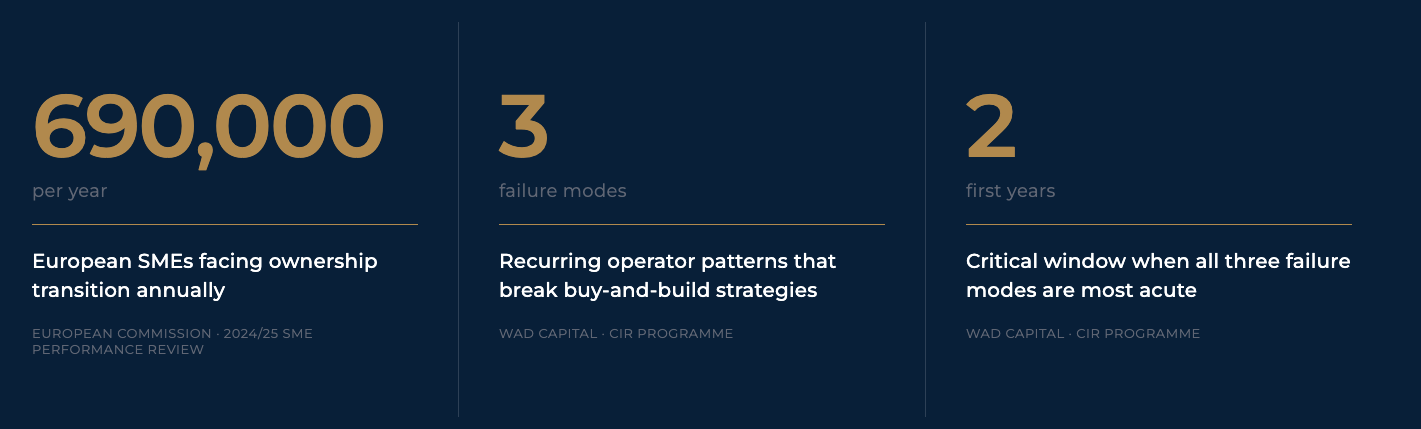
Buy-and-build in fragmented European SME markets demands one thing above all others: an operator capable of running the platform company at full performance while simultaneously sourcing, evaluating, and integrating add-on acquisitions. The financial logic of consolidation is well documented. The 2024/2025 European Commission SME Performance Review estimates approximately 690,000 European SMEs face ownership transition each year, concentrated in manufacturing, construction, and B2B services. These are precisely the fragmented sectors where consolidation produces the most durable value. What the data does not capture is what it costs operationally to be the person executing the consolidation from inside the platform company. Running an acquired SME in year one is already a demanding proposition. Running it while actively building a pipeline of add-on candidates, conducting diligence on multiple targets, and managing the legal and financing complexity of a second transaction is a qualitatively different job. The executives who underestimate this gap are not naive. They are working from the financial model of buy-and-build rather than its operational reality.
What Does the Operator Actually Do in Year One of a Buy-and-Build Platform?
The first year of ownership in any acquisition is spent learning what you do not yet know. This sounds obvious. The practical implications are not.
An SME with 25 years of operating history has accumulated processes, relationships, and informal knowledge structures that exist nowhere in documented form. The founder's head is the company's institutional memory. The longest-serving employee knows which clients are genuinely at risk of leaving versus which ones complain loudly but never actually switch providers. The estimating process for new projects has undocumented variables that everyone on the team understands and no one has ever written down. None of this appears in the information memorandum.
WAD Capital's CEO-in-Residence programme has a structured Transition and Communication phase that begins immediately post-close. The objective is not transformation. It is orientation. Who are the people who actually run this organisation day to day, regardless of their title? Which client relationships are genuinely fragile and which are structurally embedded? Where are the operational processes that need documentation before they exist only in someone's head who might leave?
The CIR who completes this orientation phase properly is not yet thinking about add-on acquisitions. They are thinking about not breaking what they acquired.
Add-on activity that begins before the platform is stable accelerates the risk of losing the very foundation on which the consolidation is supposed to be built.
What Are the Specific Operator Challenges That Break Buy-and-Build Strategies?
Three failure modes recur across SME consolidations. They are not about capital or market selection. They are about the person in the platform CEO role.
The first is attention fragmentation. An operator pursuing an add-on while simultaneously managing a new management team, a seller's residual involvement, and a client base that is watching the transition closely will eventually be present in neither activity at the level the situation demands. Diligence on an add-on candidate requires weeks of focused analysis. Running a platform company in its first year requires daily operational presence. Most people cannot sustain both at a high standard concurrently. The ones who try often produce mediocre outcomes in both: an add-on that closes with insufficient diligence and a platform that develops operational problems while the CEO's attention was elsewhere.
The second is integration sequencing. When a first add-on company closes before the platform has developed the reporting infrastructure, management routines, and cultural norms to absorb it, you are not building a group. You are combining two organisations that are both in transition simultaneously, with one leader trying to hold both together. Operational leverage requires a platform that has its core functions running at a baseline level, covering shared procurement, pooled technical talent, and common back-office processes. A platform company that still runs its finances on a spreadsheet and schedules jobs through a WhatsApp group is not ready to integrate an add-on, regardless of what the financial model projects.
The third is hiring lag. An operator who identifies a strong add-on candidate and begins diligence needs to know, with some confidence, that the platform company can continue to function effectively while the CEO's attention is partially diverted. That requires having developed a layer of management below the CEO who can make operational decisions independently. In most acquired SMEs, that layer does not exist on day one. Building it is a first-year priority that directly enables or constrains the entire buy-and-build timeline.
How Does the NexVolta Platform Illustrate These Challenges in Practice?
NexVolta, the energy and electrical works platform Guy-Louis de le Vingne built trough the acquisition of Mignone SA in Manage, Hainaut, in November 2025, illustrates what the integration challenge looks like specifically in businesses where a large share of revenue comes from public sector clients.
Public sector contracts in Belgium's construction and electrical works market tend to be stable and renewable on predictable timescales. They are also relationship-dependent in a specific way: procurement officers at Belgian municipalities and regional authorities know their suppliers personally and make vendor continuity decisions based partly on that relationship history. An incoming CEO in this context has a clear first-year priority, alongside everything else an operator manages: demonstrating that the quality of service delivery and the continuity of technical capability has not diminished. That task competes directly with any move toward early add-on activity.
What Does Buy-and-Build Look Like in Practice for a Specialist Manufacturer?
HBI Tyres and Wheels, the Netherlands based industrial and agricultural tyre manufacturer acquired by Michaël Vandelaer in January 2026, illustrates a different dimension of the same challenge: the add-on logic in a manufacturing business with proprietary brands differs entirely from a service consolidation play.
HBI produces tyres and rims under the Delcora® and Bandenmarkt® brands for the agriculture, earth-moving, and industrial sectors. The consolidationthesis here is not geographic rollup of fragmented service operators, as it is in HVAC or fire safety. It is OEM expansion and market reach. Serving large original equipment manufacturers requires ISO-9001 certification, custom manufacturing capacity, and technical credibility with industrial customers who have strict supplier qualification processes.
Adding to a platform like HBI means identifying businesses that enhance manufacturing capability, extend geographic distribution, or cover adjacent product categories that existing customers already want to buy. Each of those add-on criteria requires the platform CEO to evaluate targets through a manufacturing and product lens rather than a service delivery lens. Michaël Vandelaer's background in sustainability and operational experience across circular economy and waste-to-value sectors is the specific profile that makes him credible in those OEM conversations. The sector fit between operator and platform matters before the financial model is ever opened.
How Does the WAD Capital Cohort Model Address Buy-and-Build Execution Risk?
The three operator failure modes described above, attention fragmentation, integration sequencing, and hiring lag, are not unique to any particular sector or deal size. They are structural features of the buy-and-build model that every platform CEO encounters in some form during the first two years of operation.
WAD Capital's cohort model addresses them through collective intelligence rather than individual isolation. A group of CEOs-in-Residence operating acquired companies across adjacent sectors means that the executive who acquired an electrical works company is months ahead in operational pattern recognition compared to the CIR closing a construction services deal in the same period. The knowledge about what to prioritise in the early team communication phase, which financial reporting infrastructure to build before the add-on pipeline opens, and how to sequence the conversation with the founder about post-close involvement, circulates through the cohort continuously rather than being reconstructed from scratch by each new arrival.
This is not primarily a networking benefit. It is a compression of operational learning curves. The decision about when to pursue a first add-on is made with data from operators who have already faced that same decision in adjacent sectors, rather than in isolation from the model assumptions made before the platform company was ever acquired.
WAD Capital's structured Business and Financial Planning phase is where this preparation begins in earnest: establishing the planning infrastructure, defining the strategic vision that will anchor the add-on thesis, and identifying the management development priorities that will determine whether the platform is ready for consolidation activity within the planned timeline.
The financial case for buy-and-build in fragmented European SME markets is solid. The operator case is harder and more personal. Both have to be present for the strategy to work.
Applications for WAD Capital's 2026 cohort are open at /join-cir. Programme details are at /faqs/ceo-in-residence.
