
Private Equity vs Search Fund: What Is the Difference for an Operator?
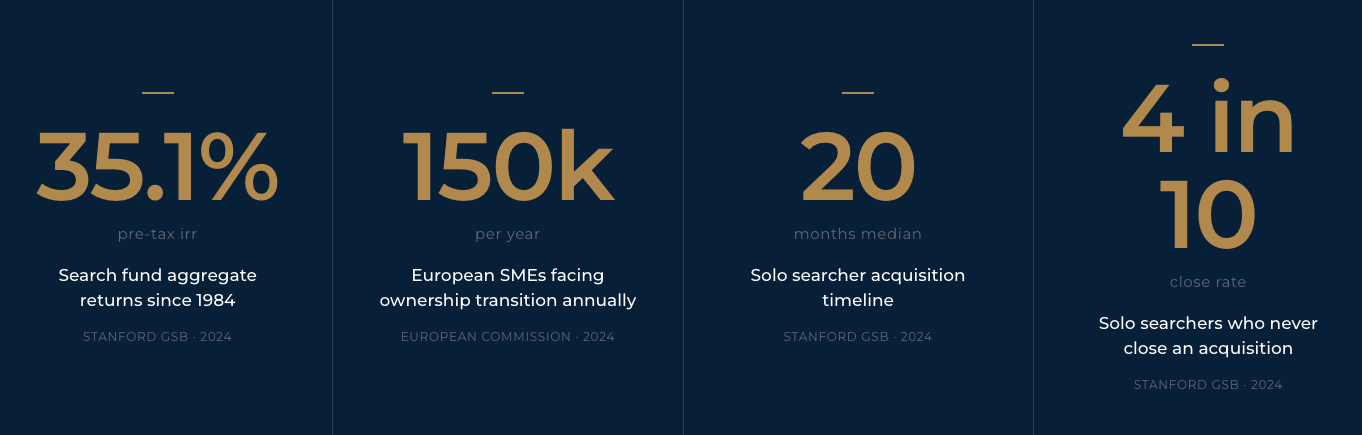
Private equity and search funds both acquire profitable businesses. What they ask of the person running the company is structurally different. In a standard private equity buyout, a fund acquires the business and installs or retains management to execute a value creation plan within a defined holding period. The manager is an employee with a mandate. In a search fund, an experienced executive finds the business, leads the acquisition, and becomes its owner-operator with a meaningful equity stake. The person running the company is the principal, not the appointee. Institutional ETA* programmes such as WAD Capital's CEO-in-Residence Programme preserve that ownership structure while supplying the infrastructure, deal sourcing, acquisition financing, legal templates, and a cohort of peers, that solo searchers assemble from scratch over the first year of their search. The 2024 Stanford GSB Search Fund Study tracked 681 search funds since 1984 and recorded a 35.1% aggregate pre-tax IRR.
What Is the Standard Private Equity Model and What Does It Require from the Operator?
Private equity acquires businesses with a specific financial objective. The fund raises capital from institutional and private investors, deploys it into acquisitions, improves the business operationally or strategically, and exits within a defined period typically three to seven years at a higher valuation than entry. Returns compound from the combination of leverage, operational improvement, and the difference between entry and exit pricing.
The operator in this structure — whether a retained founder, a hired CEO, or a newly placed executive — executes a mandate set by the fund. Performance targets, reporting cadences, and strategic priorities flow from the fund's investment thesis. The manager's compensation is typically salary plus a bonus tied to performance against agreed metrics. Carried interest exists in some structures but is rarely the dominant driver of an individual manager's economics.
This is a well-understood employment arrangement in a specific financial context. It is not ownership in the sense that matters to an experienced executive who wants to make decisions about the business they run.
Private equity in Europe is also structurally selective about size. The economics of a leveraged buyout require businesses that can support meaningful debt loads, produce audited accounts under consistent standards, and generate management information systems capable of quarterly institutional reporting. The companies that meet those requirements are concentrated at the upper end of the market. According to the European Commission's Annual Report on European SMEs (2024), approximately 150,000 SMEs face ownership transition each year across the EU. The majority of those businesses are in the €1–5 million EBITDA range — exactly where most buyout funds are not structurally set up to operate.
What Is a Search Fund and How Does the Operator's Role Differ?
A search fund is a vehicle through which an individual executive raises capital to fund a search for a company to acquire, closes the acquisition with backing from the same (or expanded) investor group, and becomes CEO with a meaningful equity stake in the business. The model was first documented at Harvard Business School in 1984 and developed at Stanford GSB through the following two decades. It is now tracked systematically across North America, Europe, and international markets.
The structural difference from private equity is ownership. The search fund operator is the principal. They chose the target, they led the diligence, they negotiated the terms, and they own a material share of the business they are now running. The decisions they make about hiring, capital allocation, growth strategy, and operational priorities are their own. The fund backs the operator; it does not direct them.
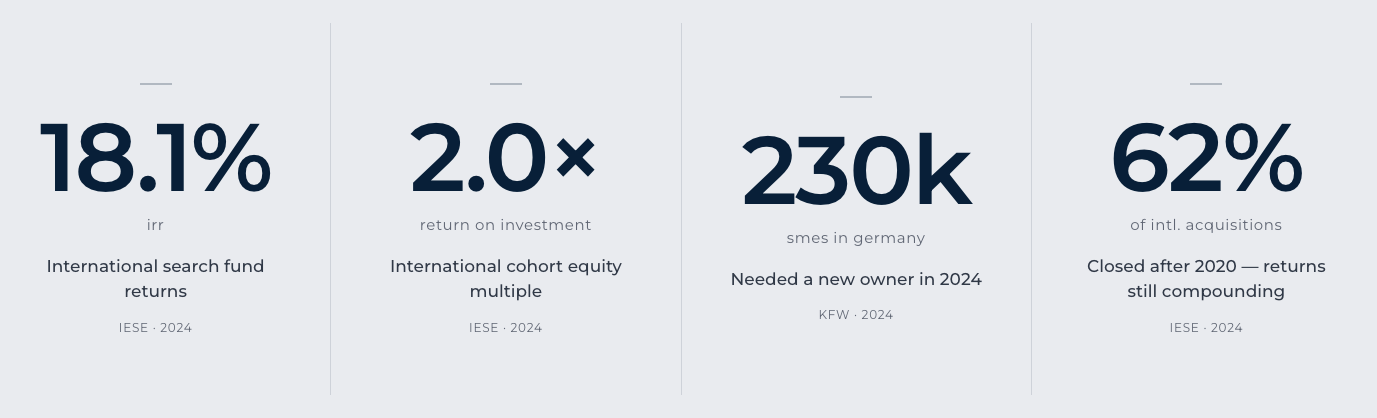
The 2024 IESE International Search Fund Study, which tracks 320 search funds across 40 countries outside North America, records an IRR of 18.1% and a return on investment of 2.0x for the international cohort. That figure sits below the 35.1% recorded in the Stanford US and Canadian dataset for a structural reason: 62% of all international acquisitions tracked by IESE were completed after 2020, giving the majority of those companies fewer than four years to compound returns that the Stanford data shows are heavily back-loaded. Early European cohorts sit at the same point on the return curve that early US cohorts occupied in the mid-1990s.
What Are the Practical Differences in Day-to-Day Operations?
Three things distinguish running a business as a search fund operator from running one as a PE-backed manager.
The first is timeline. Private equity holds for three to seven years. Decisions about capital deployment, hiring, and operational investment are made within that window. A search fund operator typically holds for longer, which changes the calculation on decisions with a longer payback horizon. Installing a new ERP system in year two makes different sense if you plan to own the business for a decade than if you need to present a clean exit story in year four.
The second is the absence of a pre-existing mandate. A PE fund typically arrives with a thesis: reduce cost base by X%, expand into market Y, acquire two add-ons in 18 months. The manager executes. A search fund operator built their own thesis before acquisition. They chose the sector, mapped the competitive landscape, interviewed industry experts, and formed a specific view on where the value creation opportunity sits. The acquisition decision itself was theirs.
The third is accountability. When the business underperforms, a PE-backed manager reports to a board and a fund. The decisions that led to the underperformance were often not entirely theirs to begin with. A search fund operator owns the outcome in both directions.
What Does the Search Phase Look Like in Practice?
The structural challenge of the individual search fund is the search itself. The 2024 Stanford GSB Search Fund Study records a median acquisition timeline of 20 months for solo searchers. That time is not primarily spent evaluating companies. The first several months of a solo search go toward building the infrastructure to evaluate companies: choosing and configuring a CRM, writing outreach sequences, identifying target companies across fragmented national registries, and establishing financing relationships with investors who may not yet be familiar with the asset class.
The KfW Nachfolge-Monitoring Mittelstand study (2024) found 230,000 German SMEs alone needed a new owner in 2024. The supply of transferable businesses is not the constraint. What compounds the timeline is the absence of infrastructure on the searcher's side, not the absence of opportunity on the market side.
What Is an Institutional ETA* Programme and How Does It Change the Model?
An institutional ETA* programme is a structured alternative to the individual search fund. Rather than each executive building their own sourcing, financing, and operational infrastructure from the ground up, the programme provides those elements centrally to a cohort of executives searching simultaneously.
WAD Capital's CEO-in-Residence Programme operates this way. A cohort of approximately fifteen executives joins the programme and follows a structured 12-step acquisition framework. Each CIR develops their own investment thesis and sources their own target, but does so using shared infrastructure: a Deal Intelligence Platform for target identification and prioritisation, legal and financial templates tested across completed acquisitions, and a cohort of peers working through the same process in different sectors at the same time.
The cohort element is operationally significant. When Frédéric Schillingwas working through the acquisition of Groupe Jordan in Hainaut, he was part of a cohort that included executives operating across different sectors and geographies at the same stage of the acquisition process. Real-time experience circulates across the group in a way that solo searchers, by definition, cannot access.
How Does Private Equity Financing Compare to Search Fund Financing?
In a standard buyout, the fund provides equity, the deal is layered with debt financing from banks or credit funds, and the capital structure is designed to amplify returns through leverage. The manager does not invest personal capital. They are not on the hook for the debt service.
In a solo search fund, the searcher raises search capital from investors, deploys it over 18 to 24 months, and then goes back to those investors for acquisition financing once a target is identified. The capital structure varies: seller financing, bank debt, and equity from the search fund investors combine differently in every deal. The searcher has typically not arranged any of this before the search begins.
In an institutional ETA* programme, WAD Capital provides 100% of acquisition financing through WAD Capital Fund I, a Belgian privak (pricaf privée) regulated by the FSMA. No personal capital is required from the CEO-in-Residence, though co-investment is encouraged for alignment. The financing question is resolved before the search begins rather than negotiated deal by deal under time pressure.
Which Model Is Right for an Experienced Executive Considering Acquisition?
The honest answer depends on what the executive is optimising for.
Private equity employment at the operating level offers institutional stability, a defined mandate, and salary plus performance compensation. It does not offer ownership, strategic autonomy, or the return profile of a carried equity stake in a business you built.
A solo search fund offers full ownership and strategic autonomy. It also requires the searcher to build their own infrastructure, manage their own investor relationships, and absorb the friction of a 20-month average search on a depleting capital base. Four in ten solo searchers never close a deal, according to the 2024 Stanford data.
An institutional ETA* programme compresses that infrastructure problem. The ownership dynamic remains: the CIR sources their own target, runs their own diligence, and becomes CEO with a meaningful equity stake. The difference is arriving on day one with a functioning Deal Intelligence Platform, tested legal templates, a structured acquisition framework, and a cohort of peers whose real-time experience circulates across the group.
For a mid-to-senior executive who wants to own and run a business rather than manage one for a fund, understanding which of these structures fits their situation is the first practical step. The CEO-in-Residence programme FAQ covers the WAD Capital model in detail. Applications for Cohort 2026 are open at /join-cir.
