
What Happens Between Handshake and Closing: The 90-Day Path from Term Sheet to Acquisition
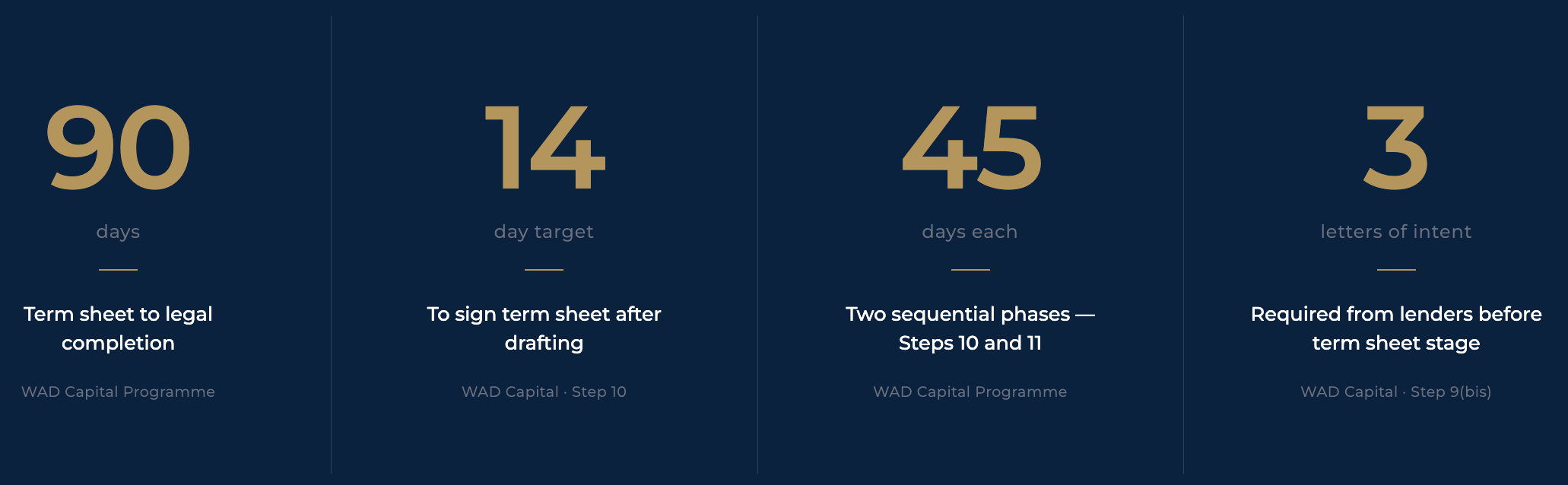
In a structured SME acquisition, the period from signed term sheet to legal completion typically runs 90 days, organised across two sequential phases. At WAD Capital, this window is documented as Step 10 (Submit Term Sheet, 45 days) and Step 11 (Confirmatory Due Diligence and Final Preparations, 45 days). Step 10 formalises valuation, payment terms, and post-acquisition roles, with a target of both parties signing within 14 days of the draft. Step 11 reconfirms all due diligence findings, establishes the new legal entity, installs the board of directors, and finalises financing arrangements. When acquisition financing involves an institutional co-investor such as Wallonie Entreprendre alongside a senior lender, each party's documentation requirements overlap and sequencing creates real scheduling risk. Closing Day is the start of Step 12: Leadership Transition and Communication, the first 30 days of the new chapter. The European Commission estimates approximately 150,000 SMEs across the EU change ownership each year. For every one of those transactions, the 90 days between agreement and completion is the highest-anxiety window the founder will experience.

What Does the Term Sheet Stage Actually Involve?
The term sheet is not the end of negotiation. It is a formalisation of intent that still leaves open questions.
Step 10 runs for 45 days. Within that window, the incoming CEO drafts a term sheet covering valuation methodology, payment structure, the roles of both parties post-acquisition, and any clauses specific to the business or the founder's situation. Then comes negotiation. Most founders have not been through a business sale before. The terminology is unfamiliar, and the instinct is to slow down at precisely the moment the process requires momentum.
WAD Capital's target within Step 10 is both parties signing within 14 days of drafting. Term sheets that sit unsigned for weeks accumulate doubt on both sides. Small uncertainties grow into renegotiated clauses, which extend timelines, which create more uncertainty.
For a founder, the practical implication is straightforward: get your questions answered before the term sheet is drafted, not after. What happens to your employees during the transition? What is the incoming CEO's plan for the first three months? What does your own involvement look like post-closing, if you want one? The time to raise these is in conversation before the document, not as redlines against it.
A signed term sheet is a milestone, not a completion. Due diligence is not finished. Financing is not confirmed. The legal structure does not yet exist. What has happened is that two parties have agreed, in writing, on the shape of a deal they both intend to close.
What Happens During Confirmatory Due Diligence?
Step 11 is where most deals either hold together or begin to quietly come apart.
The objective is not to discover new information. Comprehensive due diligence has already produced a full report that supported the investment committee's decision. Step 11 verifies that the picture still holds. An EBITDA figure that shifted between preliminary and final review. A key employee who handed in notice. A supplier contract that turns out to be personal to the founder rather than to the business. These are the things that surface in confirmatory due diligence, and any of them can change deal terms or, in rare cases, unwind a transaction.
Four workstreams run simultaneously. Jurimesh, WAD Capital's legal technology partner, handles contract review, compressing what would be weeks of manual legal analysis into a structured workstream. The new legal entity is created — the holding company through which the acquisition is made must exist before closing can happen. The board of directors is appointed and key management roles are confirmed. Financing arrangements are finalised.
In WAD Capital's Belgian acquisitions, financing typically combines WAD Capital Fund I as majority investor with a senior lender and a co-investor. Mignone SA, the Manage-based construction and electrical works company founded in 1987 by Donato and Ida Mignone, which closed in November 2025 as the platform forNexVolta, involved both WAD Capital and Wallonie Entreprendre as financing partners. Wallonie Entreprendre, the public investment body for Wallonia, has embraced the search fund model as a vehicle for SME succession in the region. Its involvement reduces leverage from senior debt, improving the deal's risk profile for the bank. The trade-off is process: Wallonie Entreprendre has its own investment committee, its own documentation, and its own timeline. That timeline requires planning in advance.
This is why Step 9(bis) of WAD Capital's programme requires a minimum of three letters of intent from banks or financial institutions before the process advances to Step 10.Guy-Louis de le Vingne, who became Founder and CEO of NexVolta, entered the term sheet phase with financing validation already in hand. For a founder watching from the other side of the table, that is the answer to the question almost nobody asks directly: is the money actually there?
The KPI for Step 11 is delivery of the final due diligence report confirming readiness for acquisition and compliance with all legal and financial requirements. When that report is delivered and financing is committed, the deal is ready to close.
What Does Closing Day Involve, and What Comes Immediately After?
Closing Day is the moment the share purchase agreement is executed, funds transfer, and legal ownership changes. Thirty years of ownership changes in an afternoon.
What happens the next morning is where Step 12 begins.
The objective of Step 12 is not transformation. It is continuity. The first 30 days focus on leadership transition and stakeholder communication. Where existing leadership is changing, the process allows for the outgoing management to stay on temporarily, supporting the handover while the incoming CEO gets oriented. A founder who has personally managed supplier relationships for two decades holds knowledge that no data room contains. The transition period is when that transfers, or fails to.
Within Step 12, direct communication goes to every stakeholder group: employees, suppliers, customers, shareholders where applicable. What will change, and what will not change. The incoming CEO is introduced. Regular meetings are established so stakeholders are not left to infer what is happening from rumour.
The KPI for Step 12 is simple to state and genuinely difficult to achieve: successful transition of leadership, and clear communication to all stakeholders.
What Does WAD Capital Do Differently During the Closing Window?
Most buyers manage the closing process reactively. Something surfaces in confirmatory due diligence and they respond. A financing condition is not met and they negotiate a workaround.
WAD Capital's 12-step programme documentation exists specifically to prevent that. The steps, timelines, and KPIs are defined in advance. Step 10 has a 14-day signature target. Step 11 has parallel workstreams with a defined completion KPI. Step 12 has stakeholder communication requirements that start on day one. No other institutional acquirer in the European SME succession space has published process documentation at this level of specificity.
The 90 days from term sheet to closing are uncomfortable regardless of how structured the process is. The deal might still not close. But there is a meaningful difference between uncomfortable-and-structured and uncomfortable-and-opaque. A founder who understands what is happening at each stage, what each party is doing, and what the decision points are can get through those 90 days without it consuming the energy required to run the business they are still responsible for.
If you want to understand what WAD Capital's approach looks like in practice, the portfolio shows the completed acquisitions. The CARE-PROFIT page explains the framework that guides how WAD operates businesses after the closing day.
