
The First 90 Days: How a New CEO Learns a Business They Just Bought
A new CEO who has just acquired a small business spends the first 90 days running a structured learning operation, not executing a plan. The diligence data room delivered the financials, the customer concentration figures, and the contract list. It did not deliver how the business actually works. That comes from sitting in on customer conversations, riding along with the senior technician, watching three quotes get prepared from start to finish, reading three years of monthly sales reports, and identifying which six suppliers carry the operational weight. The 2024 Stanford GSB Search Fund Study reports 35.1% aggregate IRR across 681 search funds, and that return is built in the first year of operational understanding, not bought at close.
What Did Diligence Tell You, and What Did It Miss?
Diligence is a financial exercise dressed as a comprehensive one. You spent three to six months building a model. You know the EBITDA margin, the customer concentration, the contract terms. You know which assets sit on the balance sheet at what depreciation schedule. You do not know how the business runs.
That is not a failure of diligence. It is a structural property of it. Diligence is calibrated to answer one question: is this business worth the price we are paying? It is not calibrated to answer the question you actually need answered after close: how does this thing operate, and where are the points of fragility I cannot see from a data room?
The 2024 European Commission SME Performance Review estimates that approximately 150,000 SMEs across the EU face ownership transition each year. The ones that get acquired well are the ones where the new CEO accepts that diligence ends at signing, and the next phase is a different kind of investigation. You are no longer trying to decide whether to buy. You are trying to decide what to do on Tuesday.

Why Customer Conversations and Ride-Alongs Are the Highest-Value Use of Week One
The first thing to understand is what the customer actually buys. Not the product line description in the marketing materials. The actual transaction. Why this customer, of all the options available to them, chose this business. Whether the relationship is held together by price, by the technical specification, by a single person on either side, or by twenty years of accumulated trust that has nothing to do with what is on the invoice.
You will not learn this by reading the customer list. You will learn it by being in the room when the conversation happens. In week one, ride along on the customer visits the head of sales has scheduled anyway. Listen for three things. What the customer praises specifically. What they complain about as asides. And what they assume the business does that the business does not actually do, or vice versa. The third category is the most useful one. Misalignment between what customers think they are buying and what the business thinks it is selling is where future churn lives, and it is invisible from the inside.
Steven Bourgeois, who built OmniSecur on the foundation of Alsec SA in Nivelles, walked into a 1987-founded fire safety and security business with four decades of technical compliance work behind it. The financial profile was clear from diligence. What was not clear, and could not have been, was which long-tenured customers stayed because the technical work was excellent and which stayed because a particular technician had been servicing their building for fifteen years. Knowing the difference matters when those contracts come up for renewal.
Apply the same logic inside the business. A ride-along with a senior field technician produces information that no operations review can replicate. You will see which routing decisions are made on the fly because the formal process does not match how customers actually want to be served. You will hear the side comments about which jobs the team prefers, which they avoid, which clients are easy and which are difficult. The trick is to treat it as a learning exercise, not an audit. If you arrive with a clipboard, the technician will perform the version of the job they think you want to see. If you arrive curious, you will see the actual job.
How to Read the Data Without Pre-Loading Conclusions
The data the business already generates is your most underused asset in the first 30 days. Pull three years of monthly sales reports. Not summarised. Line item. Sit with them for half a day with no agenda other than to see what is in them. Look at seasonality, customer concentration trends, gross margin by product line over time. Look at which months were anomalous and try to find out why before asking anyone.
Three patterns will surface that the business itself has not noticed. A product line that was once a profit centre is now subsidising another part of the business. A customer that the team thinks is growing has actually been declining for two years. A pricing decision made three years ago has compounded into a margin problem that nobody has framed as one because the absolute numbers still look fine.
The reason these patterns are visible to you and not to the existing team is straightforward. They have been close to the data for years. Each individual deviation has a reason that made sense at the time, and the cumulative drift becomes invisible because every step of it was justified. You arrive without those explanations, which is uncomfortable for a week and analytically valuable for a quarter.
The same logic applies to suppliers. Most acquired SMEs have between forty and three hundred suppliers on the books. Six to twelve of them carry the operational weight. The accounts payable ledger gives you spend by supplier, which is a starting point but a misleading one. A supplier you spend €40,000 a year with might be entirely substitutable. A supplier you spend €4,000 a year with might be the only certified provider of a component a major contract requires. The question is not how much you pay them. It is what happens if they stop tomorrow. Some long-tenured suppliers will quietly raise prices in the next renegotiation, testing whether you understand the relationship well enough to push back. The right time to identify which is which is before any of those conversations happen.
What WAD Capital's Observation-First Principle Means Operationally
Observation-first is sometimes heard as do nothing for 90 days. That is not what it means. It means sequence your actions correctly. Stabilise before you optimise. Understand before you restructure. None of this prevents you from addressing genuine problems that need urgent attention. If there is a cash flow issue, you address it. If a compliance risk is active, you fix it. Observation-first does not mean inaction in the face of things that are actually on fire.
What it prevents is the more common failure mode: the new CEO who arrives with a plan, announces it in week two, reorganises in week six, and then wonders at month four why execution is sluggish and morale is poor. That is not caused by a bad plan. It is caused by a correct plan deployed into an organisation that has not yet been given any reason to trust the person deploying it, and into a business the new CEO has not yet learned well enough to know which parts of the plan need adjustment. The principle is a sequencing rule for the first 90 days, not a posture.
How the Deal Intelligence Platform Bridges Diligence and Operations
The analytical infrastructure that supports the search phase does not stop at close. WAD Capital'sDeal Intelligence Platform screens 60,000 companies during sourcing. After acquisition, the same platform shifts function. It becomes the analytical environment in which the new CEO maps suppliers, tracks customer concentration in real time, and runs the same disciplined analysis post-close that they ran during diligence.
This matters for two reasons. First, the analytical work of the first 90 days does not depend on whatever spreadsheet infrastructure the acquired business happens to use. SMEs in the €1–5M EBITDA range typically run on Excel files maintained by one or two people, with reporting cadences that emerged organically rather than being designed. Having a configured analytical environment ready on day one collapses what would otherwise be six weeks of data plumbing into a few days. Second, it preserves continuity between the thesis the CIR wrote during the search phase and the operational decisions they make after close. The investment memo identified the value creation hypothesis. Post-acquisition, the platform is where the hypothesis gets translated into measurable operational KPIs that can be tracked from week one.
A solo searcher closing a deal walks into a business with a laptop and the founder's QuickBooks file. A CIR closes with the same QuickBooks file plus an analytical environment refined across multiple completed acquisitions.
What the CIR Programme Looks Like in Practice (Days 30–90)
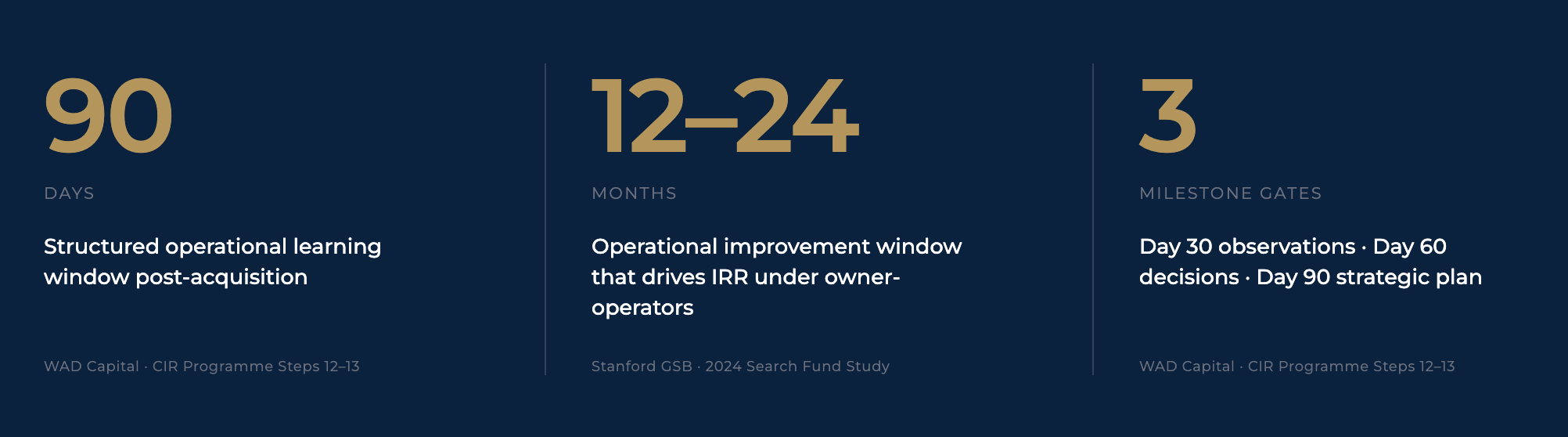
The objective is alignment on short and long-term goals. The activities cover cultural integration, operational streamlining where feasible, and the formal launch of the post-acquisition strategic plan.
The practical content of the period is more specific. By day 30, the customer ride-alongs and operational ride-alongs from week one should have produced a written set of observations. Not a strategy document. A working notebook of what surprised you, what confirmed your thesis, what contradicted it, and which questions you still cannot answer. By day 60, the supplier mapping is complete and the data review has surfaced the two or three operational questions that need decisions in the next quarter: whether to renegotiate a maintenance contract, whether to invest in a CRM upgrade, whether to address a margin compression in a specific product line. These get framed during this period, not made yet.
By day 90, the strategic plan is presented to the team. The new performance framework and KPIs are communicated across the organisation. By this point, the plan has been informed by 90 days of operational learning rather than 90 days of intent. The team hears it as a direction the new CEO developed partly because of what they told them, which is significantly more credible than a plan announced in week two.
What You Should Have Learned by Day 90
By day 90, the new CEO of an acquired SME should be able to answer the following without consulting anyone else. How the business makes money, with the operational mechanics filled in. Which customer relationships are structurally durable and which are personal. Which employees are load-bearing for which functions. Which suppliers are substitutable and which are not. What the business does well that should be preserved. What it does poorly that the team already knows about and is waiting for permission to fix.
You should also be able to answer the harder question: what would I have done differently in diligence if I had known then what I know now? The answer is rarely that you would have walked away from the deal. It is usually that you would have priced or structured one or two things differently. That answer is useful both for the next acquisition and for setting the right expectations with the WAD Capital investment committee about how this business will perform against the original thesis.
The 2024 Stanford GSB Search Fund Study reports an aggregate pre-tax IRR of 35.1% across 681 search funds since 1984, with median EBITDA growth of 25% in acquired companies. That growth is not produced by the entry multiple. It is produced by 12 to 24 months of operational improvement under owner-operator management, and the foundation for that improvement is the work done in the first 90 days. The first 90 days are the cheapest period of the entire ownership cycle. Time spent learning has no incremental cost and very high return. Time spent acting before learning has the inverse profile.

