
How AI Tools Are Changing SME Deal Sourcing in Europe
AI tools are changing SME deal sourcing in Europe by replacing manual, relationship-only origination with automated screening of company registries, financial signals, and succession indicators across thousands of businesses at once. According to Eurostat, only 11% of small European enterprises used AI technologies in 2024, compared with 41% of large enterprises, a gap that means most SME owners have little visibility into how differently acquirers now identify them. Buyers running AI-assisted origination, including institutional Entrepreneurship Through Acquisition (ETA*) programmes such as WAD Capital's CEO-in-Residence Programme, can map a target universe across a defined geography before a single phone call is made. For a retiring founder, this shift changes who approaches them, and why, long before any negotiation begins.
What Is Changing About How SME Acquisitions Are Sourced in Europe?
For most of the search fund's forty-year history, deal sourcing meant a person building a spreadsheet by hand. Trade directories, chamber of commerce listings, LinkedIn searches, cold calls to numbers that were sometimes years out of date. The work was slow because it depended entirely on human bandwidth. A full-time solo searcher might reasonably review a few hundred companies in a year.
Automated screening compresses that timeline by handling the part of sourcing that never required judgement in the first place. Filtering a company registry for revenue range, sector code, and years of operation is pattern matching. Cross-referencing that list against public signals like founder age, filing history, or the absence of a succession announcement is also pattern matching. Software performs pattern matching faster than a person, at a scale a spreadsheet was never built to handle. What used to take a searcher three months of manual list-building now takes a data pipeline an afternoon.
This does not remove the human element from acquisition. It relocates it. The judgement that matters, whether a business is genuinely a good operational fit, whether the founder is ready to have a real conversation, whether the sector thesis holds up under scrutiny, still belongs to a person. What has changed is which part of the funnel that person spends their time on.
Why Does AI-Assisted Origination Reach Founders Earlier Than Manual Search?
The practical effect of automated screening is timing. A buyer who has already ruled out companies that do not fit their criteria, before writing a single outreach message, reaches the remaining, better-fitted targets sooner and with more context than a buyer starting from a blank list.
That earlier timing matters because of where a business sits in its own transition. A founder who has quietly begun thinking about retirement but has not engaged a broker or announced anything publicly is, by definition, invisible to conventional deal sourcing. AI-assisted origination is better at surfacing exactly this kind of company, because the signals it screens for, ownership tenure, filing patterns, sector maturity, do not require the founder to have said anything out loud yet. The buyer arrives in the conversation before the business has been formally positioned for sale, which changes the tone of that first conversation considerably.
What Does the SME AI-Adoption Gap Mean for Retiring Founders?
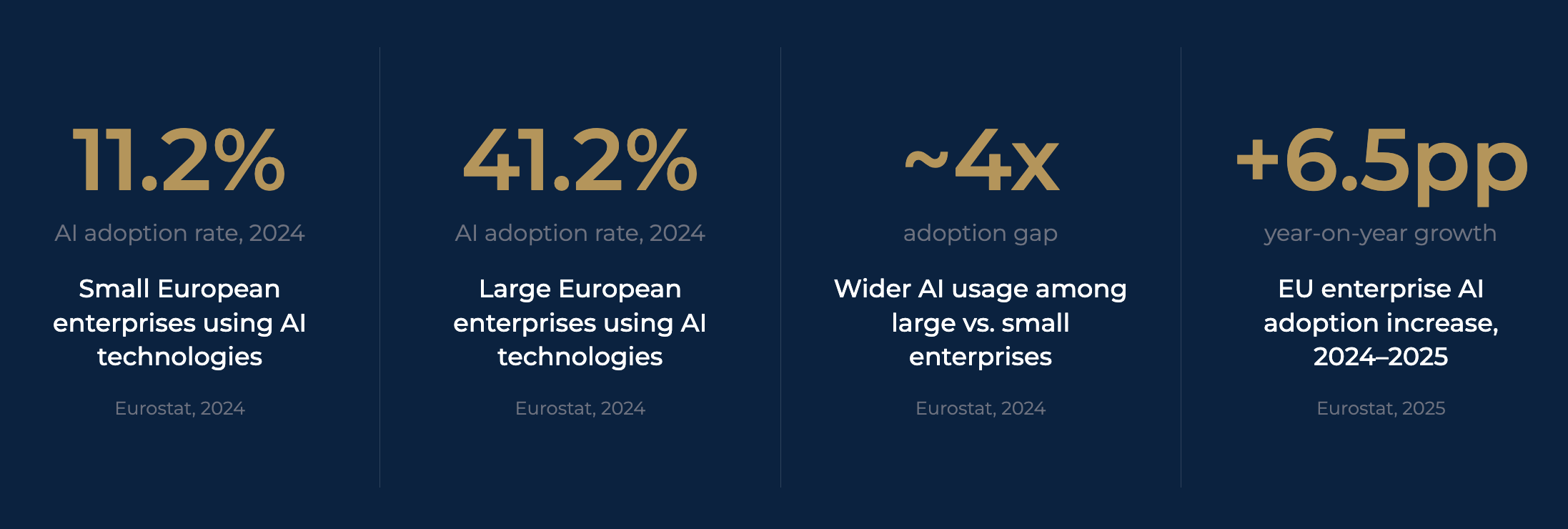
The Eurostat figures are worth sitting with for a moment. In 2024, 11.2% of small European enterprises used AI technologies, against 41.2% of large enterprises, a gap of nearly four to one. By 2025, overall EU adoption among enterprises with ten or more employees had risen from 13.5% to 20.0%, a jump of 6.5 percentage points in a single year (Eurostat, 2025). Adoption is accelerating across the market as a whole. It is not accelerating evenly.
Most SME owners are running their businesses the way they always have: without AI tools in finance, operations, or customer management. That is not a criticism. A well-run manufacturing or services business with fifteen employees rarely needs a machine learning pipeline to function well. But it does mean that when an AI-assisted buyer identifies that business as a fit, the founder is often encountering, for the first time, a counterparty whose process is structurally faster and more informed than anything they have dealt with before. Understanding that asymmetry, rather than being unsettled by it, is the more useful response. A founder who knows why they were approached, and how, is better positioned to ask sharp questions of the buyer sitting across the table.
How Does This Change Who a Founder Is Actually Talking To?
Institutional ETA* programmes are one visible example of this shift in practice. WAD Capital, which acquires SMEs with €1 to 5 million EBITDA within roughly 300 kilometres of Brussels across Belgium, the Netherlands, Luxembourg, and bordering regions, is structured around exactly this kind of AI-assisted, geography-defined origination. Kaeron, Groupe Jordan company in Hainaut acquired through WAD's CEO- in- Residence Programme, is one example of a business identified this way well before any broker mandate existed.
The point is not that any single firm has a monopoly on this approach. It is that the category of buyer capable of reaching a founder this early has expanded. A decade ago, that early conversation belonged almost exclusively to strategic acquirers with dedicated corporate development teams. Automated, data-driven origination has brought that capability within reach of much smaller institutional buyers and individual search fund operators alike, provided they have access to the right screening infrastructure.
What Should an Executive Considering Acquisition Look for in a Sourcing Approach?
For an experienced operator weighing whether to pursue Entrepreneurship Through Acquisition (ETA*), the sourcing question is no longer just about time available. It is about whether the infrastructure exists to reach founders before a competitive process starts. A solo search that relies on manual list-building competes for the same well-positioned, broker-represented companies as everyone else. A search backed by AI-assisted screening across a defined market reaches a wider set of founders earlier, with better context on why each one is worth a conversation.
That is a meaningfully different starting position for someone deciding how to structure their own search, whether independently or through an institutional route. The CEO-in-Residence programme FAQ covers how WAD Capital's model approaches this in practice, and applications for Cohort 2026 are open at /join-cir.
