
SME Leadership: Empowering the Talented Operator to Succeed
A CEO-in-Residence (CIR) at WAD Capital does not run an acquired SME alone. Shortly after an acquisition closes, WAD Capital installs a board of directors alongside the incoming CEO. That board exists to bring oversight and sector judgement into the room from the first week, not to second-guess decisions six months in. Beyond the board, a CIR draws on WAD Capital's Operations team, which covers market intelligence, deal support, talent pipeline development, and financial leadership. A cohort of peer CEOs-in-Residence, each running a different sector and a different company, adds a second layer of support: people who have already solved the exact problem currently sitting on your desk. The Stanford GSB Search Fund Study (2024) recorded an aggregate pre-tax IRR of 35.1% across 681 tracked funds. That track record was built inside structures that look like this one, not around a single founder-operator working from a spreadsheet in isolation.
What Governance Does a New CEO Actually Get?
Most executives who have run a P&L inside a large company have never had to build their own board. Someone else did it, years before they arrived. Stepping into an acquired SME as CEO removes that scaffolding entirely unless it gets replaced deliberately.
WAD Capital replaces it by design. The board installed alongside a new CIR typically brings together complementary functional expertise: finance, sector strategy, and operational scaling, so a first-time owner-operator is not relying purely on instinct in unfamiliar terrain. This is different from a governance rubber stamp. A board member with deep sector experience can tell you within one meeting whether your pricing assumption is realistic for the market you just entered. That is not something a spreadsheet tells you, and it is not something most solo-searching operators have access to on day one.
The value compounds over the holding period, not just in the first quarter. Decisions about hiring a plant manager, renegotiating a supplier contract, or timing a follow-on acquisition all benefit from a board that has seen similar decisions play out elsewhere. A first-time CEO without that structure is making each of these calls for the first time, alone.
What Does WAD Capital's Operations Team Actually Do for a CIR?
The Operations team sits underneath the board and works with CIRs on a rolling basis, not just around milestone events. Market intelligence means someone is tracking sector dynamics in your vertical even when you are heads-down running the business. Deal support means the infrastructure for a follow-on acquisition, financial modelling, legal templates, sourcing tools, does not need to be rebuilt from scratch if a buy-and-build opportunity appears eighteen months into your tenure.
Talent pipeline development addresses a problem most new SME owners underestimate: finding a plant manager, a finance lead, or a commercial director for a €2 million EBITDA business in Wallonia is not the same exercise as recruiting for a multinational. The pool is smaller, the process is more relationship-driven, and a team that has done it before across other portfolio companies has patterns a first-time CEO does not.
Financial leadership from the Operations team means a CIR is not simultaneously the CEO, the CFO, and the board's primary source of financial reporting discipline. That separation matters more than it sounds. Founders who ran these businesses for thirty years often kept the finances close and informal. Institutionalising that function properly, without losing the operational intimacy that made the business work, is one of the harder balancing acts in the first year.
Why Does the CIR Cohort Function as a Support Structure, Not Just a Network?
Peer support in most executive contexts means occasional networking. A dinner, a conference panel, an exchange of business cards. The CIR cohort at WAD Capital works differently because every member is solving structurally similar problems at different points in time.
A CIR three months into running an HVAC platform in Hainaut and a CIR working through the early integration of a pharmaceutical distribution business face different sectors but the same category of decisions: how fast to introduce change, how to read whether a department head is quietly resisting, when to bring the board a problem versus solving it first and reporting the outcome. That shared vocabulary, built from lived experience rather than case studies, is what makes the cohort function as infrastructure rather than as a social layer bolted onto the programme.
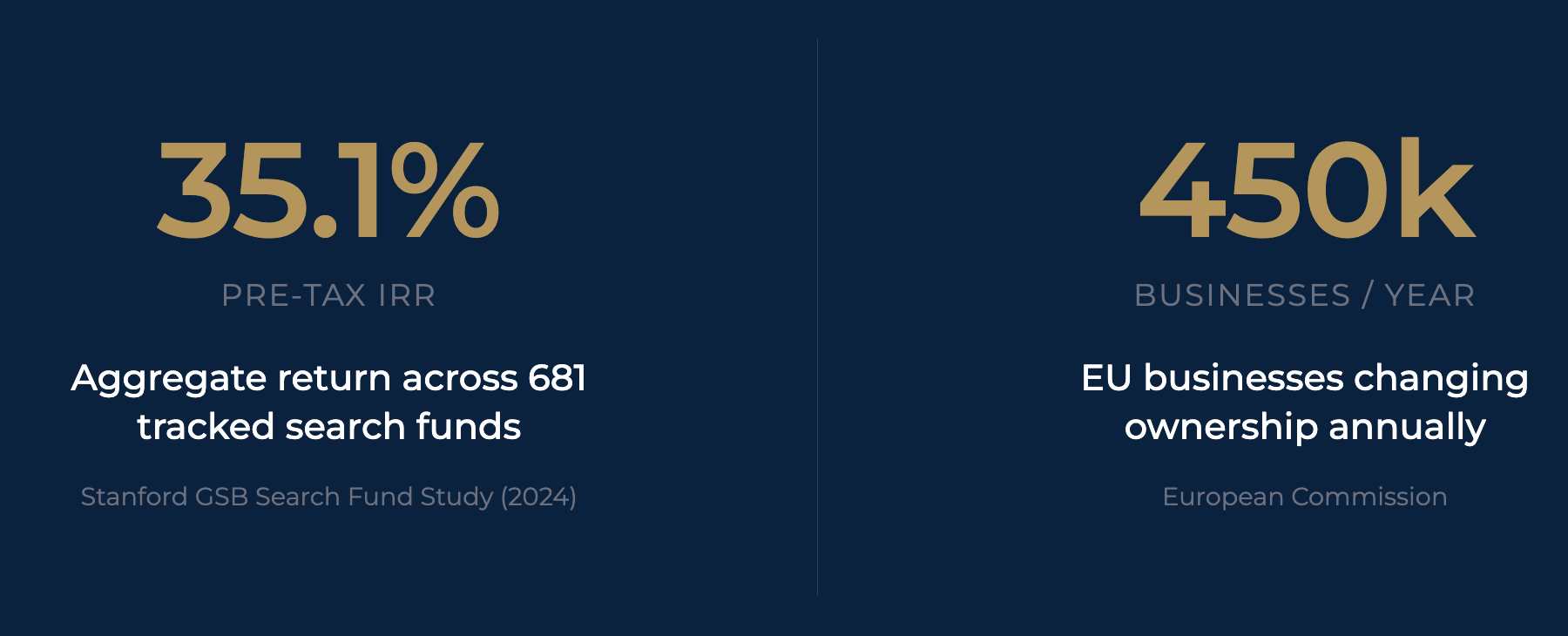
The European Commission estimates that roughly 450,000 businesses change ownership across the EU each year, with a substantial share unable to find a qualified buyer. That scale of opportunity means WAD Capital's model has to work for operators moving into genuinely different sectors, from healthcare to data technology to physical security, at the same time. A support structure that only worked within one industry would not scale. One built around shared operating challenges, rather than shared sector knowledge, does.
What Does This Look Like in Practice?
Kaeron, the HVAC platform built around the acquisition of Groupe Jordan in Farciennes, Hainaut, is a useful illustration. Frédéric Schilling, previously with P&G and Goodyear, became CEO of the roughly 110-person business when the acquisition closed in October 2025. Jean-Luc Stavaux, who founded and built the company, chose to reinvest and stay involved after the handover rather than exit entirely.
That combination, an incoming CEO backed by institutional governance and a founder who remained present to transfer relationships and technical knowledge, reduces a specific kind of risk that solo-operator acquisitions do not manage as well. Schilling did not need to simultaneously learn the HVAC sector, build financial reporting discipline, and negotiate authority with long-serving staff without any structural backing. The board and the Operations team existed before he needed them.
How Is This Different From Building Support Alone?
A solo search fund entrepreneur assembles their own board, usually from personal investors and a handful of advisors willing to donate time. That board typically meets quarterly and knows the business only through what the entrepreneur chooses to report. There is nothing wrong with this model. It has produced strong outcomes across the search fund industry for decades. It is also slower to construct and thinner in day-to-day usefulness than a pre-existing institutional structure.
The difference shows up most clearly under pressure. When a supplier renegotiation goes badly or a key employee threatens to leave, a solo operator is making a judgement call with whatever personal network they can reach that week. A CIR inside WAD Capital's structure has a board member who has seen the same situation in a different portfolio company, an Operations team that can pull relevant data quickly, and peers who dealt with a comparable moment recently enough to remember exactly what worked.
None of this replaces the operator. The CEO still makes the call, still owns the outcome, and still has to be the person the team trusts day to day. What changes is how much of that judgement is being formed in isolation versus informed by structure built specifically to support it.
For executives evaluating whether Entrepreneurship Through Acquisition is the right path, the operating support that exists after the acquisition closes deserves as much scrutiny as the financing and search infrastructure that gets most of the attention beforehand. The programme mechanics are covered in detail at /faqs/ceo-in-residence.
