
What Female Entrepreneurs Should Know About the European SME Succession Crisis
Around 450,000 European SMEs change ownership every year. Approximately 150,000 of those transfers fail, according to Eurochambres data citing European Commission figures, and the businesses don't get sold to a capable successor. They close. The jobs disappear, the supplier relationships unwind, and the institutional knowledge built over 30 years walks out with the retiring founder.
That's the structural problem. Female entrepreneurs in Western Europe are almost entirely absent from the group positioned to solve it.
This post explains what the European succession crisis actually looks like in numbers, why the gap in female participation in entrepreneurship through acquisition is both large and structurally addressable, and what WAD Capital's CEO-in-Residence programme offers female executives who are ready to lead an acquisition in 2026.
The succession crisis, by the numbers
One third of EU entrepreneurs are expected to retire within the next ten years, putting close to 7 million businesses and 30 million jobs at risk, according to research cited in recent European Commission literature. These are not failing companies. Most of them are profitable, have established client bases, experienced staff, and in many cases decades of operating history. The problem is purely one of ownership transfer: the founder wants to exit, no credible successor is ready, and without a structured handover the business has a reasonable chance of closing rather than continuing.
The €1-5M EBITDA band, where WAD Capital operates, is particularly exposed. Companies of that size are too large to pass informally to a family member with no management experience, and too small to attract serious attention from conventional private equity, which needs larger cheque sizes to justify the overhead of a deal team. The result is a gap in the market that experienced operators can fill, provided they have access to acquisition capital.
That last clause is where most talented executives stop reading. They assume capital access is the barrier. For most structures, it is.
Where female entrepreneurs fit in this picture
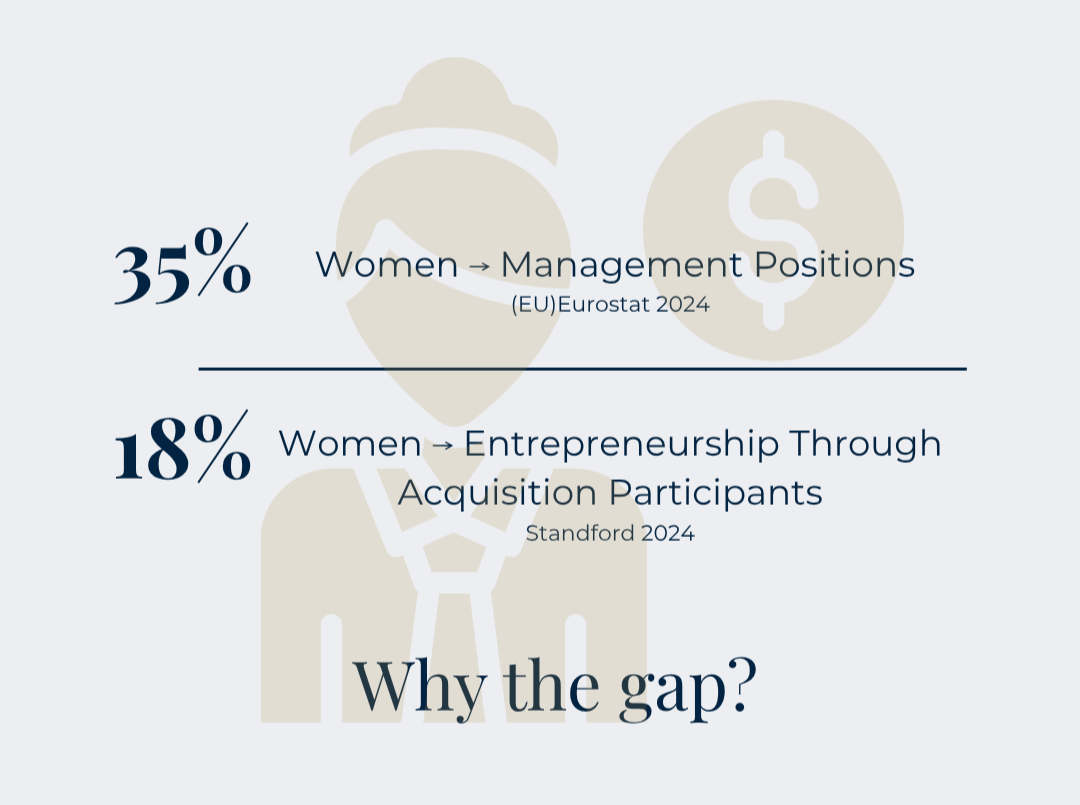
Women account for approximately 73% of all "missing entrepreneurs" in the EU, the gap between actual and potential female business ownership, according to the 2023 OECD and European Commission Report on Missing Entrepreneurs. Only about one third of businesses in the EU are started by women, despite women representing more than half the European population. In Belgium specifically, Eurostat data from 2020 shows that only 13-14% of senior executive positions in the largest listed companies are held by women, placing Belgium among the lowest-performing Western European countries on this measure.
In the ETA asset class specifically, the participation gap is even more pronounced. The 2024 Stanford GSB Search Fund Study noted increasing female participation among searchers, but women remain a small minority of principals in the model globally. The IESE International Search Fund Study 2024, which covers 320 international search funds across 40 countries, reports growing diversity among principals without quantifying the gender split, which is itself informative about how far the baseline sits.
The practical consequence is straightforward: a large cohort of retiring SME founders is looking for successors, the pool of qualified operators actively pursuing acquisitions is small, and female executives are underrepresented within that pool by a substantial margin. For a woman with the right operational background, that's a less crowded market.
The structural barrier that ETA removes
The conventional route to business ownership requires either inheriting a business, building one from zero, or self-funding an acquisition. Self-funded acquisitions of €1-5M EBITDA businesses typically require equity contributions of several million euros from the buyer personally, plus the ability to arrange debt financing and manage a deal process over 18-24 months without a salary. Most people, regardless of gender, cannot do this. Female executives face the additional factor that access to growth capital is structurally harder: the European Commission and EIB have both documented the gender finance gap, noting that women-led businesses exhibit lower risk profiles and higher repayment rates yet continue to face greater difficulty accessing institutional financing.
Entrepreneurship through acquisition through a sponsored model like WAD Capital's changes the capital structure entirely. WAD Capital provides full acquisition financing from a committed fund. The CEO-in-Residence receives a monthly management fee during the search phase, a competitive salary post-acquisition, and an equity stake of approximately 20% vesting in three stages based on value creation. The personal capital requirement drops to zero. The structural barrier that stops most qualified operators from pursuing acquisition, and that disproportionately affects female executives who face additional headwinds in accessing institutional capital, is removed by the model's design.
What remains as the selection filter is the quality of your thinking about a sector and a target company.
What Nina Bos's candidacy actually looked like
Nina Bos spent 20 years building three ventures across Italy, Croatia, and Dubai, including a successful exit. She is currently a CEO-in-Residence at WAD Capital, focused on the Corporate Events & Experiential Marketing sector in Belgium.
Her background is not a standard Belgian corporate career. Three countries, multiple ventures, an exit. She applied the same professional framework any CIR candidate applies: identify a sector where you have a credible right to win, build an investment thesis, and defend it in a 10-15 page memo to WAD Capital's investment committee.
The memo is worth pausing on. This is not a CV application. You are not submitting credentials and waiting for a callback. You are writing an investment case, identifying the acquisition target profile, explaining why you are the operator best positioned to run that business, and outlining how you would create value over a five-to-seven year hold period. The filter is analytical. Not where you went to school, not which corporate you came from, not whether you match a demographic template that has historically dominated Belgian executive leadership.
WAD Capital evaluates over 500 candidates annually and selects approximately 10 per cohort. The selection criteria are documented: operational track record, demonstrated P&L ownership or functional leadership at appropriate scale, strategic clarity about sector consolidation dynamics, and the capacity to lead a team through change. None of those criteria are gender-specific.
Nina passed that filter. She is operating in the Corporate Events & Experiential Marketing sector in Belgium, a market that is fragmented, relationship-driven, and undergoing structural consolidation as post-pandemic demand patterns stabilize. That's a thesis, not a biography.
What WAD Capital is looking for in Cohort 2026
WAD Capital is actively building its 2026 cohort and is seeking to expand female representation in the programme. To be direct about what that means in practice: there is no quota, and there is no lowered bar. The investment committee selects operators who can run acquired companies successfully because the economics of the fund depend on it. What exists is a deliberate outreach effort to address the gap between the pool of qualified female executives in Belgium and the Western Europe region, and the number of those executives who have considered ETA as a career path.
The typical CIR candidate has 10 or more years of relevant sector experience, has managed P&L or had real operational accountability, and can construct a credible thesis about a fragmented market. She has probably worked in management consulting, general management, or a specialist B2B sector. She may have had entrepreneurial experience. She has not necessarily considered buying a company before, because the capital barrier has made that an abstract proposition.
WAD Capital covers Belgium, the Netherlands, France, Luxembourg, and Germany. If you are a senior executive in one of those markets, have sector depth in an area with succession dynamics, and are at a point in your career where running a business is more interesting than advising one, the programme structure is worth understanding in detail.
What that selection committee is actually weighing, across thesis, deal execution, and Day-One leadership, is broken down in this piece: https://wadcap.com/blog/what-makes-a-successful-ceo-in-residence-at-wad-capital
Applications for Cohort 2026 are open at wadcap.com/join. The FAQ at wadcap.com/faqs/ceo-in-residence covers programme mechanics, compensation structure, timeline, and selection process in full.
