
WAD Capital sources SME acquisition targets through Generative DealFlow™, a proprietary methodology combining data analytics, automated screening, and network-driven identification. Each CEO-in-Residence (CIR) enters the programme with a structured target universe from day one rather than spending the first months of their search building basic infrastructure. The 12-step acquisition programme structures sourcing from investment thesis through to Letter of Intent in Phase 1, and from Letter of Intent to close in Phase 2. According to the 2024 Stanford GSB Search Fund Study, a traditional solo searcher takes a median of 20 months to close. CIRs working within WAD's sourcing infrastructure compress that significantly.
What Is Generative DealFlow™ and How Does It Work in Practice?
Most search fund candidates spend the first months of their search building what WAD built before they joined. A CRM adapted from a generic sales pipeline. An outreach sequence written from scratch. A target list assembled manually from company registries and professional networks. This is not a character flaw. Nobody hands you the playbook.
Generative DealFlow™ is the playbook.
At its core, it is a deal sourcing engine that runs continuously across the target market, combining proprietary data analytics, automated screening against WAD's investment criteria, and active network intelligence from the GP team and existing CIR cohort. When a new CIR joins, they are not starting a search. They are inheriting a live, filtered pipeline that has been running since before their first day.
The platform is not a sales pipeline retrofitted for M&A. Financial profiles, succession signals, ownership structures, and sector classification are built into the architecture. Research that would take a solo searcher weeks compresses to focused analytical hours.
How Does the Sourcing Phase of the Programme Actually Work?
The 12-step acquisition programme structures the search across two phases: from investment thesis to Letter of Intent (Phase 1), and from Letter of Intent to close (Phase 2). Deal sourcing is concentrated in the first phase.
Phase 1 begins with Investment Memo Creation. The CIR conducts deep market analysis, gathers competitive performance data, and validates their investment thesis through expert interviews across the target sector. The Investment Memo is reviewed and approved by WAD Capital's investment partners before the CIR approaches any target company. This is not a formality. A CIR who cannot articulate a rigorous sector thesis is not ready to evaluate the businesses that follow.
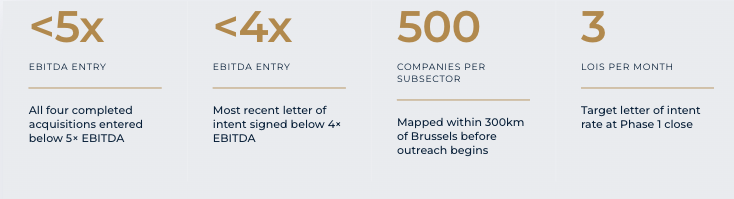
The Market Mapping phase builds the working universe. CIRs map a large population of owner-operated businesses across the Benelux within their target subsector, prioritised by investment fit and succession readiness. The mapping covers not just who is operating but which founders are approaching retirement, which operators have the technical credentials to anchor a platform, and where sub-sector geography creates natural consolidation logic. From that map, the outreach campaign launches, blending structured direct approaches with network introductions.
By the time a CIR reaches the Letter of Intent stage, they have built genuine relationships with a substantial number of business owners and developed sector understanding that a solo searcher would take considerably longer to accumulate. The majority of WAD Capital's deal flow comes through direct, off-market engagement rather than competitive processes. That sourcing context is what keeps entry pricing in succession-led transactions at levels the auction market does not reach.
Steven Bourgeois built his investment thesis around physical security compliance before identifying Alsec SA in Nivelles as his platform acquisition. By the time he was in the room with Alsec's founders, he understood their sector better than most buyers who might have appeared after a broker mandate. OmniSecur closed in November 2025.
Why Does Off-Market Sourcing Produce Lower Entry Prices?
A business that reaches a broker has already been positioned for sale. The broker's mandate is to generate competitive tension. Multiple buyers in a structured process drive valuation up. The seller enters knowing they have options.
An off-market approach reaches the founder before that dynamic exists. The CIR is often the first serious buyer the founder has spoken to. The conversation is about fit, continuity, and what happens to the workforce and the customers, rather than extracting the maximum price. That is a different negotiation, and it produces structurally different entry economics.
The Dealsuite European M&A Monitor (H2-2024) documents the pricing gap clearly. At €200,000 EBITDA, average European acquisition multiples sit at approximately 3.9x. At €10 million EBITDA, 7.2x. Businesses that reach the market through broker processes, with competitive tension built in, clear the upper end of that range. Businesses sourced directly, where the seller's primary concern is legacy and continuity rather than price maximisation, do not.
How Does the Cohort Model Change the Deal Sourcing Timeline?
A solo searcher in month six is typically still calibrating their approach to founders. Not because they are slow, but because the feedback loop of outreach, response, and refinement takes time to produce usable signal when you are processing it alone.
Inside a cohort, that loop runs across simultaneous searches in different sectors. A CIR whose outreach produces strong founder engagement shares what worked with peers whose searches are two months behind. A CIR who has just navigated a difficult confidentiality conversation brings that experience to the next cohort call. The institutional learning circulates faster than any single searcher can replicate independently.
The practical effect is timeline compression. The 2024 Stanford GSB Search Fund Study reports a median search duration of 20 months for traditional solo searchers. European contexts frequently extend this further, where cross-border complexity, language barriers, and thinner deal intermediary networks add friction at every stage. WAD's CIRs arrive on day one with a configured pipeline, tested outreach infrastructure, legal templates from multiple closed transactions, and a cohort of peers who are months ahead of them in the same process. That starting position is not available to a solo searcher.
Frédéric Schilling closed the acquisition of Groupe Jordan in Farciennes, Hainaut, in October 2025, establishing Kaeron as WAD Capital's HVAC consolidation platform. The Cohort 2024 search-to-close timeline reflected the infrastructure advantage: sector thesis validated before outreach, a mapped target universe built on proprietary data, and deal support at every phase from a team that had worked through the same mechanics across parallel searches.
What Comes After the Sourcing Phase?
Once a CIR secures a Letter of Intent, Phase 2 begins. Business and financial planning, the CARE-PROFIT impact assessment, comprehensive due diligence across HR, technical, financial, customer, and competitive dimensions, and final financing all follow in sequence. The investment committee reviews due diligence findings before the CIR proceeds to closing.
The sourcing infrastructure does not disappear once a CIR finds their target. The Deal Intelligence Platform shifts from pipeline management to supporting the analytical work of Phase 2. The search phase is where most ETA programmes lose candidates to timeline fatigue. The infrastructure described above is why WAD's does not.
If you are a mid-to-senior executive considering Entrepreneurship Through Acquisition (ETA*) and want to understand whether the CEO-in-Residence Programme is the right vehicle, the programme FAQ covers selection criteria, programme structure, and timeline in detail. Applications for Cohort 2026 are open at /join-cir.
