
What Makes WAD Capital Different from Standard Private Equity?
Standard buyout private equity in Belgium is not designed for a company with €2M EBITDA, forty years of operating history, and a founder who wants to retire. That is a structural reality, not a criticism. WAD Capital was built specifically for that gap.
The Model Most PE Firms Use
The logic of a standard leveraged buyout is internally consistent. Acquire a business using a significant layer of debt. Improve operations, reduce costs, grow revenue. Refinance as the balance sheet strengthens. Exit at a higher multiple than the entry price. The returns compound from three sources: the leverage effect, operational improvement, and multiple expansion on exit.
This works. At the right scale, with the right management infrastructure in place and a clearly defined exit path, it produces strong returns. A €50M EBITDA industrial business with an institutional finance team, audited accounts under IFRS, and four natural acquirers on the eventual buyer list is well-suited to this structure.
European SMEs with €1-5M EBITDA are a different situation. According to the European Commission's SME Performance Review, approximately 150,000 face succession challenges annually across Europe. The OECD's SME and Entrepreneurship Outlook projects that over half of European SME owners will retire within the next decade. Eurostat confirms that SMEs represent 99% of all European businesses and 65% of private sector employment. The succession problem is not marginal. It is structural, continent-wide, and almost entirely unaddressed by conventional private equity in Belgium and beyond.
A €2M EBITDA company cannot easily service the debt loads that leveraged buyout structures require. Its management layer is frequently the founder. Key customer relationships live in a personal mobile phone. The long-term supplier terms were negotiated informally over a decade of lunches. None of that is a problem. It is simply not a fit for a model built around debt service coverage ratios and quarterly board reporting.
What WAD Does Instead
WAD Capital is an institutional search fund, a model that originates from Stanford and has since produced a median pre-money IRR of 35.1% in the US and Canadian markets, according to the 2022 Stanford GSB Search Fund Study. The 2022 IESE International Search Fund Study puts the international figure at 2.0x ROI. WAD runs this model at fund scale with a cohort of roughly ten CEO candidates operating in parallel, a proprietary deal sourcing platform called the Deal Intelligence system, and a geographic focus within approximately 300km of Brussels.
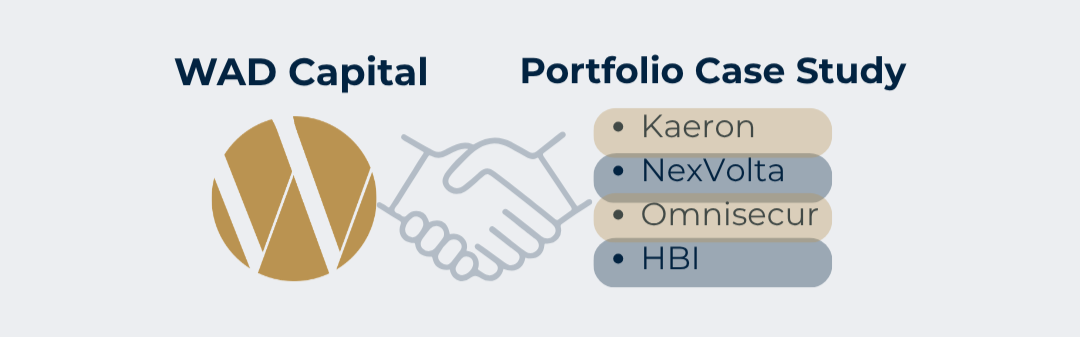
Four acquisitions were completed across Q4 2025 and early 2026. Each illustrates a different facet of how the model works in practice.
Groupe Jordan, an HVAC business with 110 employees in Farciennes, Hainaut, became the foundation for Kaeron, a consolidation platform in Belgium's fragmented HVAC market. Frédéric Schilling took over as CEO. Groupe Jordan's founder, Jean-Luc Stavaux, did not simply sell and exit. He reinvested and now serves as Sales & Marketing Director, retaining his customer relationships and sector knowledge inside the new structure. Within three months, Kaeron had completed a second acquisition, Chauffage Eric Demory in Lobbes, with Karl Verardo, a manager sourced from within the Groupe Jordan team, stepping up to lead it.
Mignone SA, founded in 1987 by Donato and Ida Mignone in Manage, Hainaut, became NexVolta under Guy-Louis de le Vigne. The company had 35 years of construction and electrical installation work, with 75% of revenue from public sector clients. Guy-Louis identified the energy transition thesis before selecting Mignone: Belgium's push toward electrification and AI infrastructure creates structural demand for exactly the skills Mignone had accumulated across three decades of public sector work. The thesis came first; the target fit the thesis.
Alsec in Nivelles became Omnisecur Group under Steven Bourgeois, building a buy-and-build platform in fire safety and security, a sector where tightening compliance regulation creates predictable structural demand. HBI, acquired in January 2026, gives Michaël Vandelaer a platform in circular economy and waste management, positioning at the intersection of EU waste reduction mandates and growing corporate sustainability requirements.
Four acquisitions. Four sectors. Four CEOs who selected their industries before they selected their companies.
A first-person account of how three of those closes actually went, from inside the deal team, is here: https://wadcap.com/blog/we-bought-three-belgian-companies-in-90-days-here-is-what-we-learned
For the Founder Considering a Sale
Valuation matters. It is rarely, however, the thing that keeps a retiring founder awake at night. The harder question is whether whoever buys the business will treat what was built with any degree of care, whether the employees who have been there for fifteen years will still have jobs in eighteen months, whether the company name will survive or be absorbed into a holding structure nobody has heard of.
Standard PE's answer to that question is structural alignment through incentives. The incoming management team has skin in the game, so their interests and the fund's interests converge. Whether that convergence extends to the founder's interests, the workforce, or the local community is not explicitly part of the model.
WAD's answer is different because the incoming CEO is not a hired manager reporting to a distant board. The CEO-in-Residence candidate spent months building a sector thesis, mapping 500 companies within their target geography, and narrowing to a shortlist before a single conversation with a founder took place. By the time they sit across the table, they have already decided this is the sector they want to spend the next decade operating in.
Jean-Luc Stavaux's reinvestment in Groupe Jordan is instructive. Founders reinvest post-acquisition when they trust the incoming structure. A retiring founder who reinvests is not doing it for a small preferred return. They are doing it because they believe the business will be better in five years than it is today, and they want to participate in that. WAD designs for that possibility rather than treating it as an afterthought.
WAD also operates within a deliberate geographic constraint. A firm that only acquires businesses it can visit on the same day a problem emerges behaves differently post-acquisition than one managing a dispersed portfolio from a capital city.
For the Executive Considering the Programme
Standard private equity offers experienced executives two participation modes: operating partner, which is advisory and fee-based, or portfolio company CEO, which is a salaried management role with performance bonuses and limited equity. Neither creates genuine ownership of the outcome.
The WAD structure is an acquisition. The CEO-in-Residence programme, which runs for 12 to 24 months, prepares the executive to source, evaluate, and close a company they will then own and operate. WAD Capital retains 80% and the incoming CEO holds 20%, vesting in three stages tied directly to value creation. No personal capital is required to enter. The fund provides 100% of acquisition financing.
What the executive brings is not capital. It is operational credibility in a sector they understand, the capacity to build a target list and run a sourcing process without a broker, and the ability to walk into a company on day one and earn the trust of a team that has been there for twenty years.
The cohort structure produces something that individual search funds cannot replicate. Guy-Louis de le Vigne closing Mignone while Steven Bourgeois is in the middle of his Alsec integration means both of them have a peer who has recently navigated the same set of problems. The first supplier renegotiation, the first month-end close without the founder in the room, the first key employee who threatens to leave: these are not hypothetical challenges. They are shared, in real time, across ten people running parallel processes.
Cohort 2026 is currently forming. Executives sourced from industry, consulting, and finance backgrounds apply through /join.
For the Investor
WAD Capital operates in a segment that most institutional capital avoids for straightforward reasons: ticket sizes are small, sourcing is labour-intensive, and the businesses lack the professional financial infrastructure that makes standard due diligence fast. The succession discount is real precisely because the market is thin. Businesses selling without a competitive auction process transact at lower multiples than those with multiple buyers at the table.
The return logic rests on several compounding factors. Entry multiples reflect the succession context. Post-acquisition value creation comes from operational improvement, digitisation of legacy processes, and where the sector supports it, bolt-on acquisitions that create genuine scale. Kaeron's second acquisition within three months of closing Groupe Jordan is the clearest early illustration of how that roll-up logic compounds. The 2022 Stanford GSB Search Fund Study puts the median pre-money IRR for this model at 35.1% in the US and Canadian markets; the IESE international figure is 2.0x ROI.
The risk profile differs materially from standard PE. These are profitable, cash-generative businesses, not turnarounds. Mignone had 35 years of operating history and a 75% public sector client base before WAD acquired it. HBI operates in a sector where EU regulation tightens the market in one direction. The downside scenario in a succession acquisition at a business with stable EBITDA is structurally different from the downside scenario in a leveraged buyout at a company with thin margins and high debt service obligations.
CARE-PROFIT, WAD's alternative to standard ESG reporting, applies across the portfolio post-acquisition. It replaces the 60-page sustainability report that would be operationally meaningless at this scale with a set of concrete, measurable KPIs tied to human capital, governance, and community impact. It is designed for businesses where the sustainability story is embedded in what they already do, not bolted on to satisfy a reporting requirement.
More on CARE-PROFIT : wadcap.com/care-profit.
The fund is structured as a Belgian privak (pricaf privée), regulated by the FSMA, with a 10-year term and a minimum investment of €500,000. Retiring founders are encouraged to reinvest alongside institutional LPs. Jean-Luc Stavaux did. That secondary alignment is not incidental to the model. It is part of what the model is.
